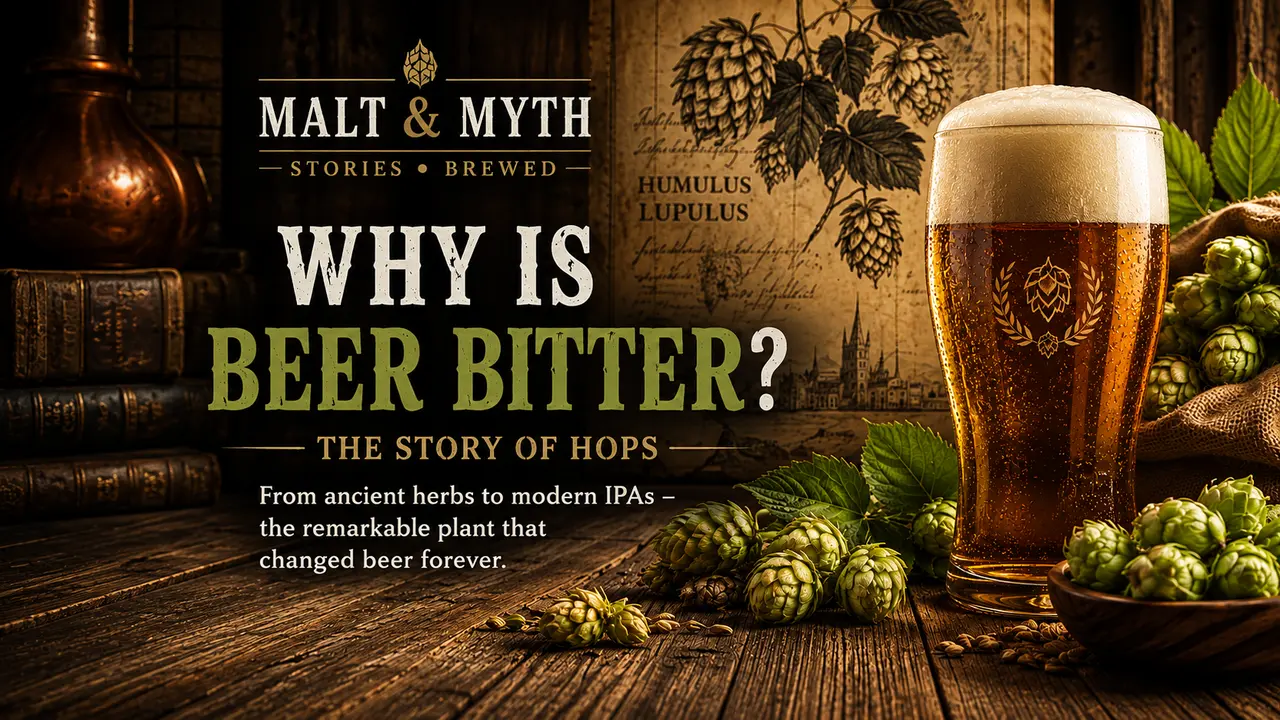
Why is beer bitter? Take a sip of almost any beer and, somewhere beneath the malt, carbonation and aroma, you will find it: bitterness.
Sometimes it is barely noticeable. In a light lager, it may simply keep the beer crisp and refreshing. In a traditional pilsner, it can be firm and herbal. And in a modern West Coast IPA, bitterness can become one of the defining features of the entire beer.
For most of that, we have one remarkable plant to thank.
Hops.
Today, hops are so closely associated with beer that it is difficult to imagine brewing without them. They appear on brewery logos, beer labels and tap handles. Craft brewers proudly advertise varieties such as Cascade, Citra, Mosaic and Simcoe. Some beers even list their hop varieties almost as if they were wine grapes.
But beer existed for thousands of years before hops became its standard companion.
So why did brewers start putting this strange climbing plant into their beer?
And why does it make beer bitter?
The answer is a story that stretches from herb gardens and medieval brewhouses to chemistry laboratories and the hop-heavy IPAs of the modern craft beer revolution.
Beer Wasn’t Always Bitter
Humans have been brewing beer for thousands of years.
Hops arrived much later.
Before hops became widespread, European brewers flavored their beer with all kinds of plants and herbs. Depending on where and when the beer was brewed, these could include plants such as bog myrtle, yarrow, juniper, heather and other local ingredients.
Mixtures of brewing herbs are often grouped under the name gruit.
There was no single universal gruit recipe. The ingredients varied from place to place, and the resulting beers could have tasted dramatically different from what we now recognize as beer.
Then hops began to change the equation.
The hop plant, Humulus lupulus, is a vigorous climbing plant in the Cannabaceae family. For brewing, it is the cone-like flowers of the female plant that matter.
Inside those cones are tiny yellow glands containing a sticky substance called lupulin.
And inside the lupulin are the compounds that would eventually transform beer.
Who First Put Hops in Beer?
This is where the history becomes less tidy than many beer legends suggest.
Hops were known in Europe long before they became a standard brewing ingredient, and written evidence connects hops with brewing by the early ninth century. Their adoption was gradual, however, and differed greatly between regions.
One famous name often appears in the story: Hildegard of Bingen.
Hildegard was a 12th-century German abbess, writer and scholar who wrote about the preservative qualities of hops. Because of this, she is sometimes presented in modern retellings as the person who discovered hops for brewing.
That makes for a great story.
It is also too simple.
Hops were associated with brewing before Hildegard wrote about them. Her writings are important evidence of how hops were understood in medieval Europe, but she did not invent hopped beer.
The real story is slower.
Over centuries, hopped beer increasingly competed with beers flavored with other herbs. Brewers discovered that hops offered a particularly useful combination: bitterness, aroma and improved stability.
Eventually, hops won.
And beer would never taste the same again.
The Chemistry Behind the Bitterness
A raw hop cone does not taste exactly like the bitterness you experience in a finished beer.
The transformation happens largely in the brewhouse.
Among the important compounds found in hops are alpha acids. When hops are added to boiling wort, heat changes these alpha acids through a process called isomerization.
The resulting compounds are known as iso-alpha acids.
These are responsible for much of the familiar bitterness of beer.
That means the brewer can influence bitterness simply by changing when the hops are added.
Hops boiled for a long time generally contribute more efficiently to bitterness.
Hops added near the end of the boil retain more of their volatile aromatic character.
And hops added after boiling — especially during dry hopping — can contribute huge amounts of aroma while creating a different balance of hop flavor and bitterness.
One plant.
Different timing.
Completely different results.
This is one of the reasons hops give brewers such an enormous palette to work with.
Hops Don’t Just Taste Bitter
Ask someone unfamiliar with brewing what hops taste like and they may simply answer:
“Bitter.”
But that is only part of the story.
Hop varieties can produce an extraordinary range of aromas and flavors.
Depending on the variety and how it is used, hops can suggest citrus, grapefruit, lemon, pine, flowers, herbs, spice, berries, stone fruit, mango and other tropical fruits.
Some varieties can even produce aromas described as resinous, grassy or dank.
This diversity comes largely from aromatic compounds in hop oils.
Because many of these compounds are volatile, boiling them for too long can drive them away. That is why brewers seeking intense hop aroma often add hops late in the brewing process or after fermentation has begun.
Dry hopping has become especially important in modern craft brewing.
Instead of boiling the hops, the brewer adds them to fermenting or finished beer. The goal is not primarily to create traditional kettle bitterness but to capture aromatic character.
Open a heavily dry-hopped IPA and that explosion of citrus or tropical fruit reaching your nose?
Much of it can come from hops that were never boiled at all.
Why Would Anyone Want Bitter Beer?
Bitterness might seem like a strange quality to deliberately add to a drink.
But beer needs balance.
Malted barley provides sugars and flavors that can range from bread and biscuit to caramel, chocolate and coffee. Without something to counter that sweetness, many beers would taste heavy or cloying.
Hop bitterness acts as a counterweight.
Think of it less as making beer “bitter” and more as giving the beer structure.
A small amount can make a pale lager taste crisp.
A firmer bitterness can sharpen a pilsner.
And a large dose can become the defining character of an IPA.
The trick is not simply adding as much bitterness as possible.
It is balancing that bitterness against everything else in the glass.
What Does IBU Actually Mean?
Beer drinkers eventually encounter three letters:
IBU.
They stand for International Bitterness Units.
IBU is an analytical measure of bittering substances in beer, historically associated especially with hop-derived iso-alpha acids.
It sounds simple enough.
A beer with 70 IBU must taste twice as bitter as one with 35 IBU, right?
Not necessarily.
This is one of beer’s most persistent misunderstandings.
Measured bitterness and perceived bitterness are not the same thing.
Imagine two beers with similar measured bitterness.
One is light, dry and low in residual sweetness.
The other is rich, strong and loaded with malt character.
The first may taste considerably more bitter because there is less sweetness and body balancing the bitterness.
Modern dry-hopped beers complicate the picture further, because hop-derived compounds beyond iso-alpha acids can also influence perceived bitterness.
So IBU is useful.
But it is not a bitterness score for your tongue.
Your palate does not have a laboratory readout.
Hops Had Another Trick
Flavor alone does not fully explain why hops became so important.
They also helped beer survive.
Hop-derived bitter compounds have antimicrobial properties, particularly against many Gram-positive bacteria. For brewers working centuries before refrigeration, sterile packaging and modern microbiology, anything that helped make beer more stable had obvious value.
That does not mean medieval brewers understood the microbiology.
They did not need to.
They could observe the result.
A beer made with hops could have practical advantages as well as a distinctive taste.
Over time, that combination helped hopped beer spread across Europe and eventually pushed many older herbal brewing traditions aside.
Bitterness had found a permanent home in beer.
From Preservation to Personality
For centuries, hops were primarily one ingredient among several that created a balanced beer.
Then modern brewing began turning them into something more.
Breeders developed new hop varieties with different combinations of bitterness, yield, disease resistance and aroma.
One variety in particular would become a symbol of a new kind of beer.
Cascade.
Developed by the USDA breeding program and released in 1972, Cascade offered a distinctive aroma profile that became strongly associated with American craft beer.
American craft brewers embraced it.
When Sierra Nevada Brewing Co. began brewing its Pale Ale in 1980, Cascade hops became central to the beer’s identity.
At the time, its assertive hop character was unusual enough that many drinkers simply did not like it.
Others loved it.
Those drinkers helped change beer.
The IPA Arms Race
As American craft brewing expanded, hops increasingly moved from supporting actor to star.
Pale ales became hoppier.
IPAs became more popular.
Then came double IPAs, imperial IPAs and beers advertising enormous IBU numbers as badges of honor.
For a period, bitterness itself became part of the competition.
How bitter could a beer become?
How many hops could a brewer fit into it?
But the story did not end with ever-increasing bitterness.
Brewers increasingly explored hops for aroma rather than simply bitterness.
Newer hop varieties offered intense tropical and fruit-forward profiles. Brewing techniques changed. Late hopping and dry hopping became increasingly important.
Eventually, a beer could contain an extraordinary quantity of hops yet taste softer and juicier than an old-school bitter IPA.
The hop revolution had evolved.
It was no longer simply about making beer more bitter.
It was about extracting every possible flavor from the plant.
One Plant, Thousands of Possibilities
Walk through a hop field near harvest and it becomes easier to understand the fascination.
The plants climb high above the ground, their stems — technically called bines — covered with green cones. Crush one of those cones between your fingers and the aroma can be astonishingly intense.
Different varieties smell dramatically different.
Traditional European “noble” hops are often associated with refined herbal, spicy and floral characters.
Classic American varieties helped introduce stronger citrus, pine and resin notes.
Newer varieties can smell intensely of mango, passion fruit, peach, lime or berries.
Brewers can use a single variety to showcase its personality or blend several varieties together.
They can change the quantity.
Change the timing.
Change the temperature.
Add them during the boil.
Add them after the boil.
Add them during fermentation.
Every decision changes the beer.
Few ingredients demonstrate the creativity of brewing quite as clearly as hops.
So Why Is Beer Bitter?
Because centuries ago, brewers discovered a plant that did several useful things at once.
Hops helped balance the sweetness of malt.
They contributed aroma.
They improved beer’s stability.
And when their alpha acids were transformed during brewing, they created a distinctive bitterness that eventually became one of beer’s defining characteristics.
What began as a practical brewing ingredient became something much bigger.
Today, hops can whisper quietly in the background of a lager or dominate an IPA with waves of grapefruit, pine and tropical fruit.
They can make beer crisp.
They can make it aromatic.
And, yes, they can make it bitter.
But perhaps the most remarkable thing about hops is that after centuries of brewing with them, we are still discovering new ways to use them.
So the next time a beer gives you that sharp little bite at the end of a sip, remember:
you are tasting a plant that changed the history of beer.
Leave a Reply