
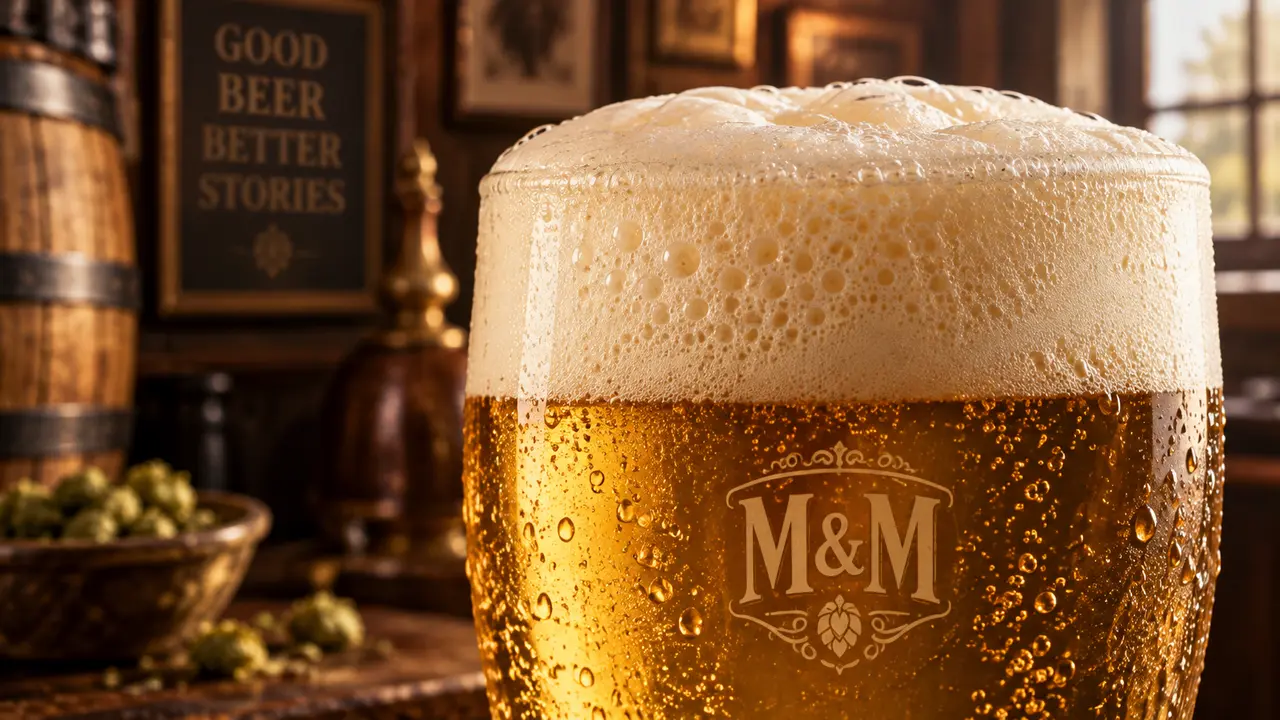
Pour a beer into a glass and something happens before you even take the first sip.
A pale lager may build a crisp white cap. A wheat beer can rise beneath a thick, creamy crown. A stout may settle under a dense head that seems almost impossibly smooth.
And sometimes the foam disappears almost as quickly as it arrived.
So why does beer foam?
The simple answer is carbon dioxide. Beer contains dissolved gas, and pouring gives that gas an opportunity to escape as bubbles.
But that only explains how the bubbles begin.
What makes beer foam last — or collapse — is a much more interesting story involving malt proteins, hops, glassware, brewing technique and some surprisingly delicate chemistry.
Beer foam is not just decoration. It is part of the beer.
It Starts With Carbon Dioxide
Fermentation produces two famous things: alcohol and carbon dioxide.
Yeast consumes fermentable sugars and produces ethanol and CO₂. Depending on how a beer is made and packaged, carbonation may come from fermentation, conditioning, forced carbonation, or a combination of these.
Inside a sealed bottle, can or keg, carbon dioxide remains dissolved in the beer under pressure. Open it and the situation changes.
When the pressure falls and the beer is poured, dissolved CO₂ begins escaping from the liquid. Tiny pockets of gas form and grow into bubbles.
Pouring more aggressively generally encourages more gas to leave the beer at once, which is why pouring straight down into a glass creates considerably more foam than carefully running the beer down its side.
But CO₂ alone does not give beer its distinctive, persistent head. Carbonated water also bubbles, yet its bubbles vanish quickly.
Beer has something else.
The Secret Is in the Bubble Walls
A beer bubble is essentially a pocket of gas surrounded by a very thin film of liquid.
Left alone, that film would quickly drain and break. For foam to survive, compounds in the beer have to help stabilize the boundary between the gas and the liquid.
This is where beer’s ingredients become important.
Proteins and polypeptides derived largely from malt can collect at the bubble surface and help stabilize the thin films around the gas. Researchers have repeatedly identified malt-derived proteins associated with beer foam, particularly Protein Z and lipid transfer protein 1 (LTP1).
Foam stability is not controlled by one molecule, however. It results from interactions among proteins, hop compounds, polysaccharides, polyphenols, alcohol, lipids and other components in the finished beer.
That means the malt that provides fermentable material for beer also contributes to the white crown sitting above it.
And malt has a partner.
Hops Don’t Just Make Beer Bitter
Hops are famous for bitterness and aroma. They also contribute to foam.
During wort boiling, hop alpha acids are transformed into iso-alpha acids — compounds strongly associated with beer’s characteristic bitterness.
Those compounds can interact with foam-active proteins and help strengthen the films around bubbles. Recent research has specifically examined the interaction between iso-alpha acids and Protein Z and found improved foaming and foam stability under experimental conditions.
So two ingredients normally associated with different jobs work together at the top of your glass.
Malt contributes important foam-active proteins. Hops contribute compounds that can help stabilize the foam.
The result can be a dense network of bubbles capable of surviving far longer than the fizz on a glass of sparkling water.
Why Some Beer Heads Last Longer Than Others
Not every beer produces the same foam.
The grain bill matters. The brewing process matters. Carbonation matters. Alcohol matters. Hop compounds matter.
Even the size and distribution of the bubbles matter. Fine, relatively uniform bubbles tend to create the dense, creamy appearance associated with stable beer foam.
Wheat beers are famous for substantial heads, and research comparing wheat and barley beers has found that differences in protein composition can contribute to differences in foam performance.
Higher ethanol levels can work in the opposite direction. Ethanol is one of several factors known to destabilize beer foam.
Beer foam is a balancing act.
And sometimes that balance is damaged after the beer has already left the brewery.
The Invisible Enemy: Fat
You can have a perfectly brewed beer and still end up with disappointing foam.
The culprit may be almost invisible.
Fat and oil are enemies of beer foam.
Lipids and other foam-negative substances can disrupt the structures that help stabilize bubbles. Even small amounts of greasy residue on glassware can therefore hurt foam formation and retention.
That residue does not necessarily mean your glass looks dirty. It can come from food, fingerprints or inadequate cleaning.
This is why professional beer service puts so much emphasis on a beer-clean glass.
A glass can look clean and still not be beer clean.
Your Glass Can Give Itself Away
There are clues that a glass is not properly beer clean.
Persistent streams of bubbles forming on the inner wall can indicate nucleation sites created by residue, particles or surface imperfections. And foam behavior itself can reveal cleaning problems.
Watch what happens after each sip. On a properly clean glass, foam often leaves rings or patches behind as the beer level falls. This is known as lacing.
Cicerone’s glass-cleaning guidance uses lacing, water sheeting and the salt test as practical indicators when checking beer glassware.
Those white traces down an empty pint glass are therefore more than an attractive pattern. They can tell you something about the beer and the glass that held it.
Does Beer Foam Affect the Taste?
Foam changes the drinking experience in several ways.
Most obviously, it changes texture. A dense head introduces a soft, creamy layer before the liquid reaches your mouth.
But aroma matters too.
Beer contains many volatile aroma compounds. Carbonation, pouring and bubble collapse all affect how aromatic compounds move from the beer into the headspace above it, where your nose can detect them.
This is one reason drinking directly from a bottle or can is a different sensory experience from pouring the same beer into a glass. A glass gives your nose much better access to the beer’s aroma.
That does not mean more foam is always better.
But a properly formed head is not simply wasted space.
Why Bartenders Tilt the Glass
The classic beer pour begins with the glass tilted.
There is a reason.
If beer is poured gently down the side of a tilted glass, less CO₂ is released immediately and foam formation stays under control. As the glass fills, the pour can become more vertical, encouraging enough agitation to build the desired head.
Pour too aggressively and the glass can become mostly foam. Pour with almost no agitation and you may produce very little head.
The ideal balance depends partly on the beer style, carbonation level, dispense system and serving tradition.
And those traditions can differ dramatically.
A “Perfect” Head Depends on Where You Are
There is no universal amount of foam that every beer should have.
In some drinking cultures, receiving a glass with a large head can feel as though the bartender has short-changed you. Elsewhere, foam is deliberately part of the serving style.
German wheat beer is traditionally associated with a substantial crown, while Czech draught culture takes foam even further.
Czech serving traditions include hladinka, with a characteristic creamy head; šnyt, with a much larger proportion of foam; and mlíko, a pour made almost entirely of wet, creamy foam.
The lesson is simple: the perfect beer head is not merely a scientific measurement. It is also cultural.
What looks excessive in one pub may be exactly what the serving tradition intends somewhere else.
What About Guinness?
Then there is the beer that made its foam famous.
Guinness Draught uses nitrogen as well as carbon dioxide to create its characteristic texture and head. Nitrogen helps produce the tight, creamy bubbles associated with the beer, while the famous surge-and-settle effect is part of its nitrogenated dispense system.
The same principle is used in Guinness Draught cans, where a nitrogen-filled widget helps recreate the draught-style surge and creamy head after the can is opened.
Nitrogenated beers have since spread well beyond stout.
It is another reminder that the bubbles above a beer can tell you a surprising amount about what happened before it reached your glass.
Can You Improve Beer Foam at Home?
Yes — and you do not need brewing equipment.
Start with the glass.
Make sure it is genuinely clean and free from oily residue. Avoid touching the inside of the glass. Use proper glass-cleaning practices and let glassware drain and air-dry rather than polishing the inside with a potentially contaminated cloth.
Then pay attention to the pour.
Begin with the glass tilted and gradually straighten it as it fills. Give the beer enough agitation near the end to form a head rather than trying to eliminate foam completely.
Finally, give the beer enough room for its head. You do not need a different glass for every style, but clean glassware of an appropriate size makes a noticeable difference.
Why Does Beer Foam?
Because beer is an unusually effective bubble-making system.
Carbon dioxide provides the gas. Pouring releases it. Malt-derived proteins help stabilize films around the bubbles. Hop-derived iso-alpha acids can interact with foam-active proteins and contribute to foam stability.
The recipe, brewing process, alcohol level, carbonation, gas composition, serving method and cleanliness of the glass all influence what happens next.
And that is why two beers poured into two glasses can behave completely differently.
The head on a beer is not empty space.
It is fermentation, ingredients, chemistry and serving technique made visible.
Next time you pour a pint, watch the foam before you take the first sip.
The beer is already telling you a story.