
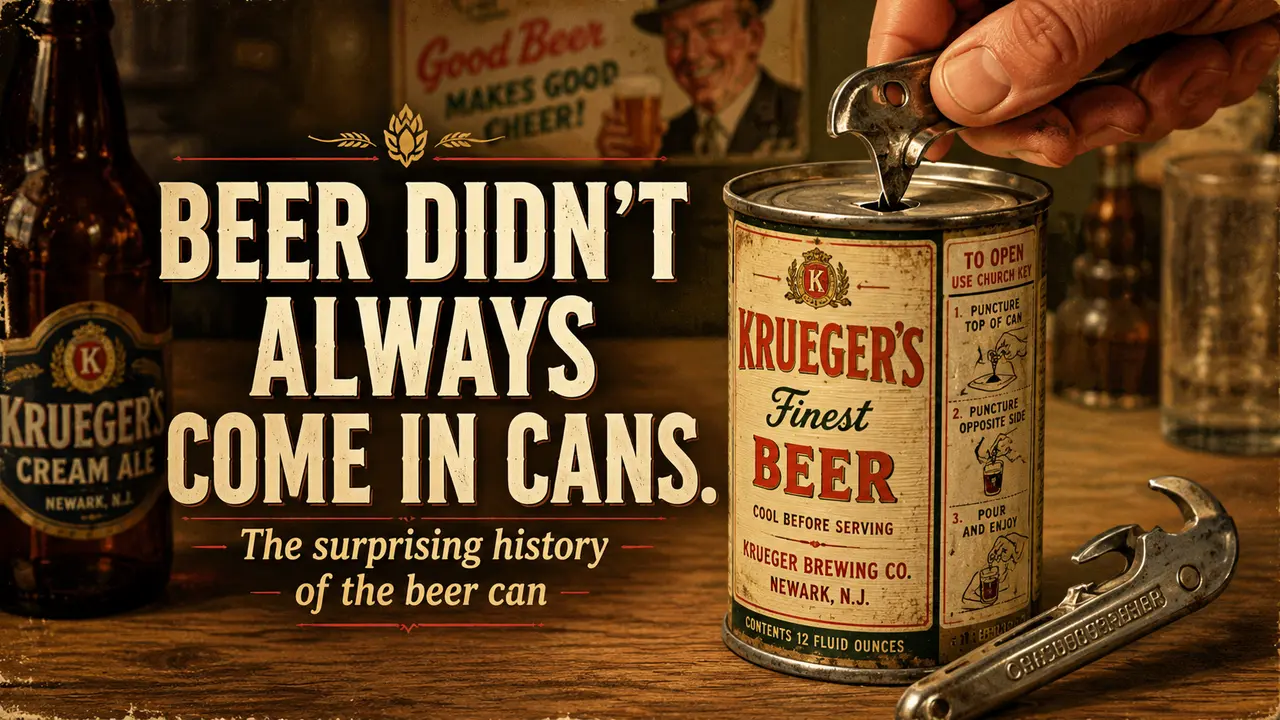
The history of the beer can begins with a problem that took decades to solve. Today, opening a beer can takes less than a second.
Hook a finger under the tab, pull, and pssst — you are done.
It is such an ordinary action that it is easy to forget how new the beer can really is. For most of beer’s long history, there was no can at all. Beer travelled in barrels, was drawn from casks, and later became widely associated with glass bottles. The familiar aluminum cylinder in a refrigerator is the result of decades of experiments in metallurgy, coatings, manufacturing and opening mechanisms.
And when canned beer finally reached drinkers in 1935, even the people selling it were not sure consumers would accept it.
Beer Was Harder to Can Than Food
By the beginning of the twentieth century, metal cans were already well established for food. Beer was a different engineering problem. It was carbonated, so its container had to withstand internal pressure. Packaging processes could expose the container to additional stresses, and the beer itself needed protection from direct contact with the metal.
The American Can Company made an early attempt to can beer in 1909, but the experiment was unsuccessful. The company returned to the problem years later. According to History, after two years of research it had developed a workable pressurized beer can by 1933, including a special internal coating designed to keep the beer from chemically reacting with the metal.
That coating was crucial. A metal container was useful only if the beer inside still tasted like beer.
The timing also mattered. National Prohibition had ended in the United States in December 1933. Breweries were rebuilding, competition was returning, and packaging companies suddenly had a legal beer market to serve again. The technology was becoming practical just as the industry was being reborn.
The History of the Beer Can Begins in 1935
A new can did not automatically mean breweries wanted it. Glass bottles were familiar. Brewers already owned bottling equipment, distributors understood bottles, and consumers knew what bottled beer was supposed to look like. A metal beer container could easily be dismissed as strange, cheap or likely to give the beer a metallic taste.
The Gottfried Krueger Brewing Company of Newark, New Jersey, agreed to work with the American Can Company. Rather than immediately betting its core home market on the new package, Krueger tested the idea in Richmond, Virginia.
On January 24, 1935, 2,000 cans of Krueger’s Finest Beer and Krueger’s Cream Ale were delivered to Krueger drinkers in Richmond. The response was remarkably positive: 91 percent approved of the canned beer, according to History.
That date is generally treated as the commercial debut of canned beer in the United States.
The result gave Krueger confidence to expand production. Other breweries quickly noticed. Within three months, more than 80 percent of Krueger distributors were handling its canned beer, and by the end of 1935 more than 200 million beer cans had been produced and sold.
A package that had seemed risky at the beginning of the year was becoming an industry phenomenon.
Why the Can Made Sense
The beer can did not succeed only because it was a novelty. It offered practical advantages over returnable glass bottles. Cans were durable, easier to stack, did not require the same consumer bottle deposit, and could chill relatively quickly. For breweries and distributors, a package that could travel without breaking and did not have to return to the brewery was attractive.
Those advantages became especially important as beer distribution expanded. During the Second World War, American brewers shipped millions of cans of beer overseas to U.S. servicemen. The can had gone from experimental packaging to a useful tool for moving beer across enormous distances.
But an early beer can would look surprisingly awkward to a modern drinker.
The First Cans Had No Pull Tab
Early beer cans were made primarily from steel and had solid tops. There was no ring to lift and no scored opening to push inward. To get the beer out, the drinker needed a separate can punch — the type of pointed opener that became widely known as a church key.
The opener punctured the metal lid, usually creating one larger opening for pouring and another smaller opening to admit air. The method was unfamiliar enough that early beer-can packaging could include instructions showing consumers how to open the container.
The Smithsonian even preserves a device called the “Tapster,” probably made around 1934. A beer can was placed inside the small pitcher-like holder; closing its lid drove an opener into the can so the beer could then be poured from the spout. It is a wonderful reminder that canned beer arrived before anyone had settled on the effortless opening experience we now take for granted.
The familiar cylindrical, solid-top design later became known to collectors as the flat-top can. But it was not the only solution.
When a Can Looked Like a Bottle
Another early form was the cone-top can. Instead of ending with a completely flat upper surface, the metal body narrowed into a cone-shaped neck that could be sealed with a crown cap, much like a bottle.
This mattered because not every brewery could afford to rebuild its packaging operation around specialized canning machinery. Cone-top designs allowed some breweries to adapt equipment and practices that were closer to their existing bottle lines.
For a time, the future shape of the beer can was not obvious. Flat tops, cone tops and other variations competed while breweries learned how best to manufacture, fill and sell beer in metal.
Eventually the flat cylindrical format won. But the next major transformation would come from changing the metal itself.
From Heavy Steel to Aluminum
The earliest beer cans were substantial steel containers. They worked, but they were much heavier than the modern can. Manufacturers continued searching for lighter materials and more efficient ways to make beverage containers.
Aluminum became one of the major breakthroughs in the history of the beer can. The Smithsonian’s National Museum of American History holds a 7-ounce Coors aluminum can dated 1959, a physical artifact from the period when the modern lightweight can was emerging.
Coors is widely associated with the commercial introduction of the all-aluminum beer can in 1959. Aluminum offered several advantages: it was light, corrosion-resistant and valuable enough to make recovery and recycling economically attractive. Coors also promoted the return of used aluminum cans, helping connect the package with recycling from an early stage.
The can was getting lighter and more modern. But the drinker still faced an irritating question: why should opening a beer require carrying a separate tool?
The Pull Tab Changes Everything
The next major chapter in the history of the beer can was about how people opened it. The answer is closely associated with American engineer and toolmaker Ermal Fraze. The often-told story begins in 1959, when Fraze found himself at a picnic with canned drinks but without a suitable opener. He began thinking about a can that could carry its own opening mechanism.
Fraze’s work led to the development of the pull-tab, or zip-top, system in the early 1960s. Commercial beer cans using self-opening tabs appeared soon afterward, eliminating the need for the church key.
For consumers, it was a dramatic improvement. Opening a can became part of the package itself: lift, pull and drink.
But the first pull tabs introduced a new problem. The metal tab detached completely from the lid. Once removed, it became a small, sharp piece of litter. Tabs accumulated on beaches, streets and picnic grounds, and could cut bare feet or be accidentally dropped into drinks.
The beer can had solved the opener problem by creating a litter problem.
The Tab That Stayed on the Can
The better answer arrived in the 1970s: an opening mechanism that remained attached after the can was opened.
One landmark design is Daniel F. Cudzik’s non-removable Stay-On Tab, associated with 1975. The Museum of Modern Art includes a 1975 aluminum beverage can with a non-removable “Stay-On Tab” opener in its design collection.
Instead of tearing away a piece of the lid, the lever presses a scored section inward while the tab itself remains attached. The principle is immediately recognizable to anyone who has opened a modern beer can.
It was a small design change with a huge practical effect. No separate opener. No loose pull tab. No extra piece of sharp metal to throw away.
After roughly four decades of commercial canned beer, the basic opening experience had finally become the one we know today.
Why Aluminum Became the Modern Standard
Modern beverage cans are engineering objects disguised as disposable packaging. Their walls are extremely thin, yet the shape and manufacturing process allow them to contain a pressurized drink. The top is designed around a controlled scored opening. Internal coatings continue to separate the beverage from direct contact with the metal.
Aluminum also has an important advantage at the end of the can’s life: it can be recycled repeatedly. A used beverage can can become raw material for another aluminum product — including another can — rather than requiring entirely new metal for every package.
Over time, manufacturers have also reduced the amount of material required to make each can. The result is far removed from the heavy steel packages of 1935, even though the basic idea remains the same: put beer inside a sealed metal cylinder that is strong enough to protect it until someone wants a drink.
The Can Also Changed Beer Culture
Packaging is easy to dismiss as something separate from beer itself, but the can changed where and how beer could be sold and consumed. It was tough enough for transport, convenient for shops and consumers, and increasingly efficient for breweries to produce in enormous numbers.
It also became a canvas. Decades of beer-can graphics, typography, brewery logos and changing fashions turned ordinary packaging into cultural artifacts. Vintage cans are now collected precisely because they preserve pieces of brewing and design history that were originally intended to be thrown away.
More recently, craft breweries have embraced the can as well. A package once associated mainly with mass-market beer became common for small and independent breweries, giving brewers a lightweight, light-blocking container with a large printable surface.
That reversal is one of the more interesting chapters in the can’s story. What began as an unfamiliar experiment became ordinary; what later seemed cheap or industrial could be reinterpreted as practical, modern and visually distinctive.
From Strange Experiment to Invisible Technology
The history of the beer can is a story of engineering becoming almost invisible. The beer can succeeded so completely that we barely notice its engineering anymore.
We do not normally think about the coating inside it. We do not think about the pressure it must contain, the decades spent reducing its weight, or the series of opening mechanisms that came before the stay-tab. We certainly do not expect to carry a pointed steel opener every time we want a beer.
We simply pull the tab.
That may be the most revealing part of the beer can’s history. In 1935, breweries had reason to wonder whether drinkers would accept beer in metal at all. Krueger tested the idea with just 2,000 cans in Richmond. Ninety-one percent of those drinkers approved, and within the same year hundreds of millions of cans followed.
Then the package kept evolving: stronger coatings, flat tops and cone tops, wartime distribution, lightweight aluminum, removable pull tabs and finally the stay-on opening mechanism.
Today the result sits in supermarkets, bars, stadiums, refrigerators and coolers around the world. It feels inevitable.
It was anything but.
The modern beer can is the product of nearly a century of solving small problems — one layer, one material and one tab at a time.