
Beer bottles are so familiar that we rarely stop to think about them. Brown, green, clear — they seem like little more than packaging choices, perhaps selected to match a brewery’s branding.
But the colour of a beer bottle can have a surprisingly important job.
For beer, light is not merely cosmetic. Under the wrong conditions, it can trigger a chemical reaction that changes the aroma of the beer dramatically. That distinctive smell often described as “skunky”? It isn’t just a figure of speech. There is real chemistry behind it.
And that chemistry helps explain why the humble brown bottle became one of brewing’s most enduring pieces of technology.
Beer Has an Enemy: Light
Beer is a complicated mixture of water, malt, hops, yeast and many compounds created during brewing and fermentation.
Hops are especially important here.
Brewers have used hops for centuries because they provide bitterness and aroma, while also contributing to beer’s stability. During brewing, hop compounds are transformed into substances known as iso-alpha acids, which are largely responsible for beer’s bitterness.
Normally, that is exactly what the brewer wants.
But expose those compounds to certain wavelengths of light and something rather less desirable can happen.
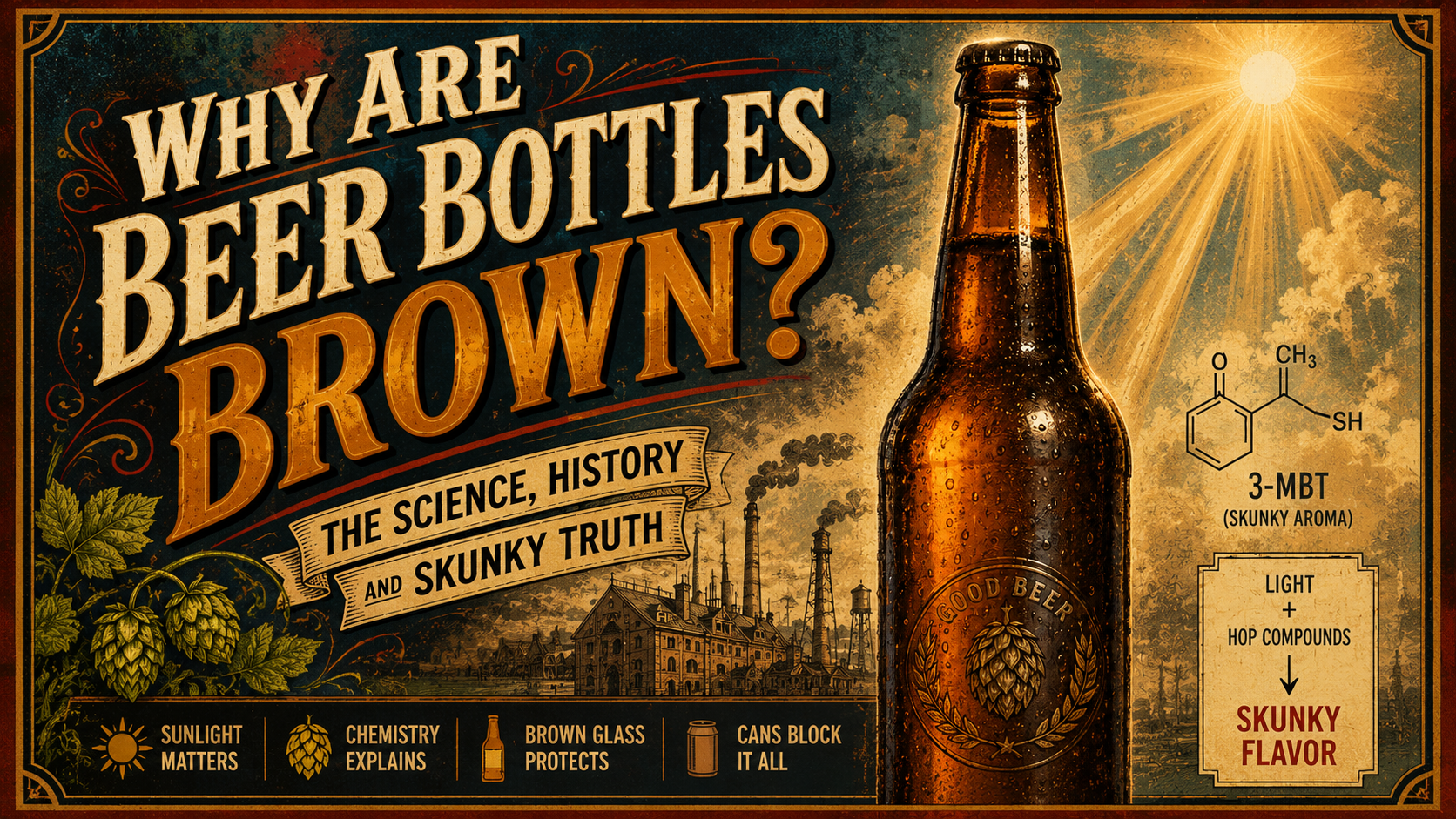
Ultraviolet and visible light, especially in roughly the 350–500 nm range, can initiate photochemical reactions involving hop-derived compounds. Riboflavin in beer acts as a photosensitizer in the best-established pathway. The reaction can ultimately produce sulfur-containing molecules.
One of the most notorious is 3-methyl-2-butene-1-thiol, usually shortened to 3-MBT.
And humans are remarkably good at detecting it.
Why “Skunky” Beer Really Does Smell Like a Skunk
The comparison with a skunk isn’t just colourful beer vocabulary.
3-MBT is a sulfur-containing thiol with an extraordinarily powerful aroma. Its odour is closely associated with the smell people describe as skunky, and its sensory threshold is only a few nanograms per litre.
This light-induced flavour fault is often called lightstruck beer.
You may also hear drinkers say a beer has been “skunked.”
The process can happen surprisingly quickly when a vulnerable beer is exposed to strong light. That means packaging isn’t merely about making a bottle attractive on a supermarket shelf. It can actually help protect the flavour inside.
Which brings us to glass.
Why Brown Glass Works
Ordinary transparent glass allows a considerable amount of visible and ultraviolet light to reach the beer.
Brown — or amber — glass blocks far more of the wavelengths that can trigger the lightstruck reaction.
It isn’t perfect protection, but it is dramatically better than clear glass and generally provides better protection than green glass.
In other words, the brown beer bottle is essentially a pair of sunglasses for your beer.
That makes brown glass a remarkably simple solution to a complicated chemical problem.
No electronics. No special mechanism. No sophisticated modern material.
Just colour.
Once brewers recognised the damaging effect of light, darker glass became an effective way to help protect beer during storage, transportation and display.
But that creates another question.
If brown glass protects beer better, why are so many famous beers sold in green bottles?
The Curious Case of the Green Beer Bottle
Walk through almost any beer aisle and you’ll find them.
Green bottles have become closely associated with several internationally recognised beer brands. For many consumers, the green bottle itself has become part of the identity of certain European lagers.
Yet from a purely light-protection standpoint, green glass is generally inferior to brown.
So why use it?
The safest answer is that history and branding both matter. Green glass has a long history in bottle making, and for some established breweries the colour became a recognisable part of the package. Over time, that visual identity acquired marketing value of its own.
You will often see a claim that shortages of brown glass during the Second World War caused European breweries to switch to green. That story is widely repeated, but strong primary evidence for it is difficult to establish, so it should be treated cautiously rather than as settled fact.
What is clear today is that green bottles are strongly associated with a number of heritage beer brands. At that point, changing the bottle isn’t simply an engineering decision anymore.
It is a marketing decision.
And marketing can be extraordinarily powerful.
What About Clear Bottles?
Clear bottles create an even more obvious puzzle.
They offer the least visual barrier between light and beer, yet some successful beer brands deliberately use them.
Why?
Because clear glass has one enormous marketing advantage: you can see the beer.
The golden colour becomes part of the packaging.
A bright, crystal-clear lager displayed through transparent glass can look refreshing before the bottle is even opened. For a brand trying to communicate lightness, freshness or a particular colour, that visual effect can be valuable.
Of course, chemistry still exists regardless of what the marketing department wants.
Modern brewers can reduce the risk by using light-stable, chemically reduced hop bittering products that are much less susceptible to the reactions that form 3-MBT.
Packaging, brewing science and branding can therefore work together.
The result is something that would once have seemed contradictory: a beer in clear or green glass that has been formulated to be less vulnerable to lightstruck flavour.
Beer Bottles Weren’t Always Brown
Glass bottles have a long history, but beer spent much of its existence being stored and transported in other containers.
For centuries, beer was commonly kept in wooden barrels and consumed relatively close to where it was brewed. Glass existed, but producing strong, consistent bottles in large quantities was difficult and expensive.
As glassmaking improved and industrialisation transformed manufacturing, bottled beer became increasingly practical.
That created new possibilities.
Beer could travel farther. It could be sold individually. Consumers could store it at home. Breweries could put their names and identities directly onto packaging.
But bottles also exposed beer to a new environment: light.
The damaging effect of light on beer was being investigated by the late nineteenth and early twentieth centuries, and dark-brown bottles proved effective at inhibiting lightstruck flavour.
The bottle was no longer simply a container.
It had become part of beer preservation.
A Tiny Chemistry Experiment You Can Smell
One of the fascinating things about lightstruck beer is that the basic principle can be experienced without laboratory equipment.
Take two identical beers that are susceptible to light damage.
Keep one protected from light and expose the other to strong sunlight briefly.
When compared, the exposed beer may develop a noticeably different aroma. In strong sunlight, trained tasters can detect lightstruck character after very short exposures.
What has changed isn’t the recipe.
It isn’t the malt.
It isn’t the yeast.
And nobody added anything to the bottle.
Light simply triggered chemistry using compounds that were already present.
It is a wonderful example of how surprisingly delicate flavour can be.
The beer can look almost exactly the same while its aroma has changed dramatically.
Cans Solve the Light Problem
There is, of course, an even simpler way to stop light from reaching beer:
Don’t let any light through at all.
An aluminium can is opaque, so it provides complete protection from light exposure.
For decades, however, cans often carried a less premium image than bottles. Modern craft brewing helped change that perception, and cans are now routine packaging for highly regarded beer.
Cans also have practical advantages: they are lighter than glass, compact and quick to chill. From the specific standpoint of light protection, their opacity is decisive.
That does not mean every beer and every can are automatically a perfect match; breweries still need to manage oxygen, seams, liners, storage and beer-package compatibility.
But the old assumption that “bottle means better beer” simply doesn’t hold up.
Packaging quality is about much more than tradition.
Does Beer Taste Better From a Brown Bottle?
Not automatically.
A brown bottle cannot improve bad beer.
It doesn’t make the ingredients better, fix poor fermentation or transform an ordinary beer into a great one.
What it can do is protect the beer from one specific source of damage.
Think of it less as improving the beer and more as helping preserve what the brewer intended.
Storage still matters.
Heat can damage beer. Oxygen can damage beer. Time changes beer. Some styles are more fragile than others.
A brown bottle left for months in a hot environment may be in worse condition than a properly stored beer in another package.
The bottle colour is therefore one part of a much larger story.
Why Brewers Still Choose Different Colours
If protection from light were the only consideration, the beer aisle would probably look rather monotonous.
Brown bottles would dominate alongside cans.
But beer packaging has never been governed by chemistry alone.
Breweries also sell history, identity and recognition.
A distinctive bottle can become inseparable from a brand. Change its colour and consumers may feel that something fundamental has changed — even if the liquid inside is identical.
That creates an interesting conflict between science and tradition.
Science says brown glass offers better protection.
Branding may say green glass is iconic.
Marketing may say clear glass shows off the product.
Engineering may say use a can.
And consumers may simply say:
“I’ve always liked drinking it from the bottle.”
All of those forces help determine what eventually appears in your refrigerator.
The Brown Bottle Is Quietly Brilliant
There is something wonderfully unglamorous about the solution.
Beer contains light-sensitive compounds.
Light can trigger chemistry that produces unpleasant aromas.
So brewers put the beer behind darker glass.
That’s it.
Yet that simple idea has protected countless bottles of beer around the world.
The brown beer bottle is an example of something we encounter constantly but rarely question. Its appearance feels traditional because we’ve seen it our entire lives.
But underneath that tradition is chemistry.
And behind the chemistry is a story involving hops, sunlight, glassmaking, industrialisation, branding and even the smell of a skunk.
Which is exactly the sort of story we like.
Because sometimes the most ordinary things have surprisingly complicated histories.
So the next time you open a brown bottle, remember: the colour isn’t there just to look good. It’s helping keep the light out — and the skunk away.