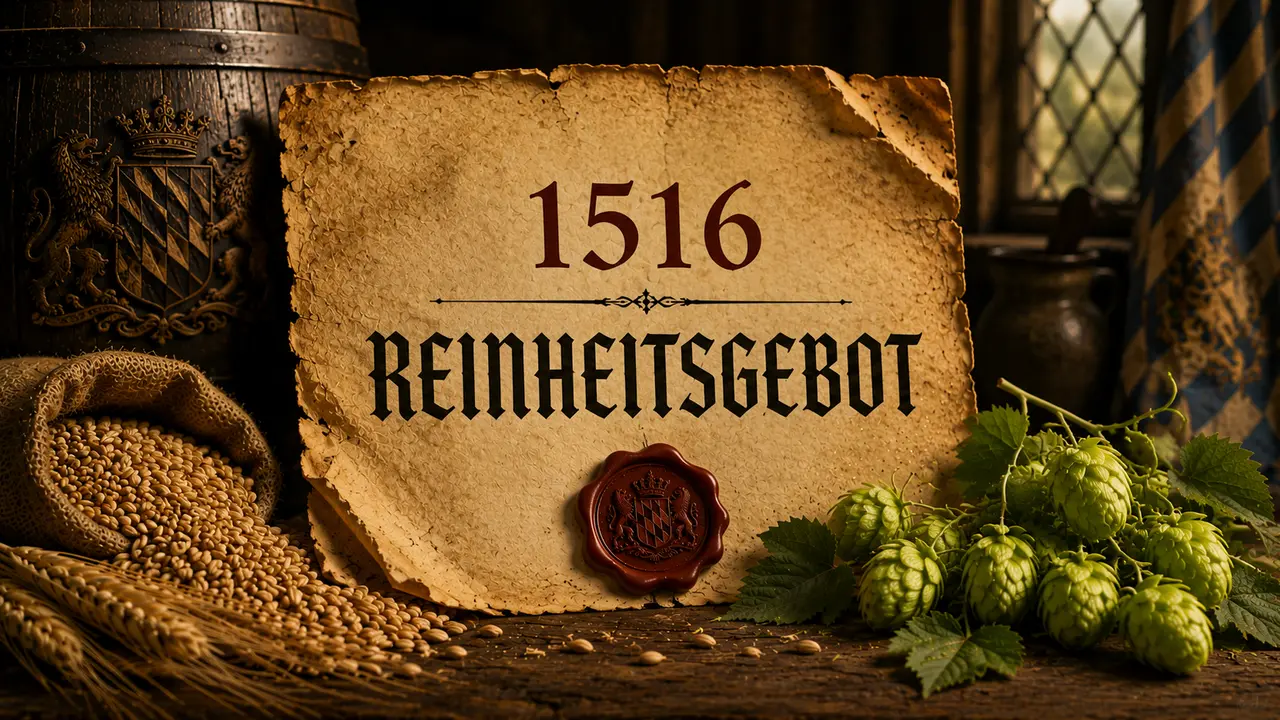
Few beer laws are as famous as Germany’s Reinheitsgebot.
The story is usually told like this: in 1516, Bavaria introduced a revolutionary purity law declaring that beer could contain only three ingredients – barley, hops, and water. For more than 500 years, German brewers have supposedly followed that simple rule, protecting their beer from inferior ingredients and preserving one of the world’s great brewing traditions.
It is a wonderful story.
It is also much more complicated than that.
The regulation of 1516 was real. Barley, hops, and water really were the ingredients named in it. And the rule would eventually become one of the most powerful symbols of German brewing.
But it was not originally called the Reinheitsgebot. It was not the first regulation to control beer ingredients. It dealt with beer prices as well as ingredients. Later rules introduced exceptions. Wheat beer presents an especially revealing contradiction. And the word Reinheitsgebot itself appeared centuries after the famous ordinance was written.
To understand the German beer purity law, we have to put the modern slogan aside for a moment and return to Bavaria.
Beer Before the German Beer Purity Law
Beer regulation did not suddenly begin in 1516.
Medieval beer was an important commercial product, and authorities had plenty of reasons to regulate it. Brewing consumed valuable grain, generated revenue, and produced a drink whose quality could vary dramatically. Local governments therefore tried to control prices, ingredients and brewing practices long before Bavaria’s famous ordinance.
The Historical Lexicon of Bavaria documents several earlier examples. Nuremberg regulated the use of barley for brewing between 1302 and 1305. Weimar had brewing rules in 1348. Landshut regulated brewing in 1409. Munich issued an ordinance in 1487 stating that beer should be brewed from barley, hops and water. In 1493, Bavaria-Landshut introduced a broader territorial brewing rule.
This matters because 1516 is sometimes presented as the moment when Duke Wilhelm IV invented the idea of beer purity. He did not. The Bavarian ordinance was part of a much longer development.
What made 1516 particularly important was its reach. After the Wittelsbach territories of Bavaria-Munich and Bavaria-Landshut were reunited, the rulers sought to standardise law across the enlarged duchy. At the Ingolstadt Landtag of 1516, Dukes Wilhelm IV and Ludwig X agreed a comprehensive Landesordnung with the Bavarian estates. Among its many provisions were rules for brewing and selling beer.
Those few lines would eventually become legendary.
What Did the 1516 Rule Actually Say?
The famous ingredient clause is strikingly simple. It says that no ingredients should be used for beer other than barley, hops and water.
That is the historical foundation of the modern Reinheitsgebot story.
But read the surrounding text and something becomes immediately clear: the ordinance was not simply a declaration about brewing purity. It first set maximum prices for beer at different times of year and regulated how beer could be sold. Only then came the famous ingredient restriction.
The rulers of Bavaria were therefore doing more than defining what ‘real beer’ should contain. They were regulating an economically important food and drink: its price, its raw materials and its trade.
That wider context is essential. Calling the provision a ‘purity law’ makes it sound like a timeless philosophy of brewing. In 1516 it was part of practical government.
Why Barley?
The choice of barley was not arbitrary.
Grain was one of the most important resources in pre-industrial society. Wheat and rye were especially important for bread. The Historical Lexicon of Bavaria notes that reserving those grains for bakers was one reason brewing increasingly relied on barley.
Barley also had practical advantages. It was regarded as a suitable and robust brewing grain and, in the late 15th century, was comparatively inexpensive.
So there is truth behind the popular ‘bread versus beer’ explanation. Restricting brewers to barley could help keep wheat and rye available for food. But it would be misleading to claim that this alone explains the 1516 ordinance. Quality control, consumer protection, price control, food supply and economic policy all formed part of the picture.
And the attempt to reserve wheat for other uses created one of the most interesting contradictions in the entire story.
The Strange Case of Wheat Beer
If beer was supposed to be brewed with barley, what happened to wheat beer?
It did not disappear.
Wheat beer production could survive through special privileges. In 1548 the Degenberg family received the right to brew Weißbier north of the Danube. Other privileged production also existed. When the Degenberg line died out in 1602, Duke Maximilian I took control of the wheat-beer privilege and expanded Weißbier brewing into a profitable ducal enterprise.
In other words, the same political system that restricted ordinary brewers from freely using wheat could profit from privileged wheat-beer production.
That is far more revealing than the simple claim that wheat was forbidden because it was somehow ‘impure’. The rules were connected to resources, privilege and economic power as well as brewing practice.
Wheat beer would eventually become one of Bavaria’s defining beer traditions – despite the famous 1516 wording specifying barley.
There Is Something Missing: Yeast
Look again at the ingredients named in 1516: barley, hops and water.
Something essential is missing.
Yeast.
You cannot make beer without fermentation, so why did the ordinance not mention it?
A common internet explanation says that brewers simply did not know yeast existed. That is too crude. Brewers clearly knew fermentation as a practical process and worked with yeast-rich material from previous fermentations. What they did not possess was the modern microbiological explanation of yeast as a living microorganism responsible for alcoholic fermentation.
The scientific understanding came much later, especially through 19th-century work on fermentation associated with Louis Pasteur.
For the lawmakers of 1516, yeast was not listed as an ingredient added in the same sense as barley, hops and water. Modern German brewing rules, by contrast, explicitly include yeast.
So the famous three-item list is historically accurate – but it should not be mistaken for a complete modern recipe for beer.
Why Hops?
Unlike yeast, hops were explicitly named.
By 1516, hops were already well established in Bavarian brewing. They supplied bitterness and aroma, but they also helped beer keep better. The Historical Lexicon of Bavaria identifies improved keeping quality as an important reason for the spread of hopped beer.
Earlier European brewing had also used herbs and herb mixtures rather than hops alone. Those traditions are often grouped under the term gruit, although ingredients and systems differed by place and period.
The growing dominance of hops gradually reshaped European beer. By specifying hops, the Bavarian ordinance reinforced a practice that had already become increasingly important.
But even the supposedly absolute three-ingredient rule soon became less absolute.
The Three-Ingredient Rule Had Exceptions
If you imagine Bavarian brewers following exactly the same three-ingredient formula without interruption for the next 500 years, the historical record gets in the way.
The Historical Lexicon of Bavaria records that a ducal decree in 1551 permitted coriander and laurel while prohibiting other dangerous substances. In 1616, another Bavarian regulation renewed restrictions on herbs and seeds but allowed moderate use of salt, juniper and caraway during brewing.
And, of course, privileged wheat-beer production existed despite the barley wording of 1516.
The point is not that the 1516 rule was meaningless. It clearly mattered. The point is that the later idea of one perfectly unchanged, three-ingredient law stretching from 1516 to the present is too neat.
Rules changed. Exceptions existed. Political boundaries shifted. Brewing technology evolved. The meaning attached to the old ordinance evolved as well.
It Wasn’t Called the Reinheitsgebot in 1516
Perhaps the most surprising fact is the name itself.
Today, Reinheitsgebot feels inseparable from 1516. Yet Wilhelm IV and Ludwig X did not issue a document with that title.
The term is a creation of the early 20th century.
The Historical Lexicon of Bavaria reports the earliest currently known use in 1909, when government official Joseph Rheinboldt used the word in a Reichstag petitions committee. The term appeared again in the Bavarian parliament in 1918, where Hans Rauch invoked the Reinheitsgebot as a brewing tradition. Some brewing-industry accounts cite that 1918 speech as the first use, but the archival research cited by the Historical Lexicon places a known example in 1909.
That difference matters because names shape memory. Calling the old rule a ‘purity command’ encourages later generations to read it primarily as a declaration about purity. The original provision was embedded in a broader regulation concerned with prices, ingredients and trade.
Over time, a practical early-modern brewing rule became a cultural symbol.
Was It the World’s First Beer Purity Law?
No.
It was not even the first regulation in the region to specify brewing ingredients.
Nuremberg, Weimar, Landshut and Munich all had earlier brewing rules. Munich’s 1487 ordinance already specified barley, hops and water. Bavaria-Landshut had a territorial rule in 1493.
The Historical Lexicon is explicit that the 1516 ordinance is neither the only nor the oldest such regulation.
So claims that the Reinheitsgebot was ‘the world’s first food law’ or ‘the first beer purity law’ should be treated as marketing-friendly simplifications, not careful history.
The importance of 1516 lies elsewhere: the rule covered the reunited Duchy of Bavaria, became enormously influential, survived in cultural memory and was later transformed into a symbol of German brewing identity.
From Bavarian Regulation to German Symbol
For much of its early history, the famous rule was Bavarian, not ‘German’ in the modern national sense. A unified German Empire did not exist until 1871.
During the 19th and early 20th centuries, brewing regulation became entangled with taxation, trade, regional identity and national legislation. Bavaria defended its brewing traditions while Germany’s political and economic structures changed around it.
In that environment, the old Bavarian rule acquired a new symbolic power. The story was irresistible: simple ingredients, centuries of tradition and a distinctive brewing culture.
The name Reinheitsgebot helped turn that history into a compact idea that consumers could immediately understand.
Like many powerful historical stories, it was based on something real while smoothing away the messy parts.
Does the German Beer Purity Law Still Exist Today?
Yes – but not as the untouched 1516 ordinance.
Modern German beer law is a later legal framework. The current Bierverordnung still protects the designation ‘beer’ and refers to brewing requirements inherited from Section 9 of the former Vorläufiges Biergesetz. Those provisions distinguish, among other things, between bottom-fermented and top-fermented beer. The traditional rule for bottom-fermented beer specifies barley malt, hops, yeast and water, while top-fermented beer has historically been allowed additional types of malt and certain sugars.
German law also allows beer legally produced abroad to be marketed in Germany as beer under specified conditions. That reflects, in part, the European legal environment. In 1987 the European Court of Justice ruled against Germany’s attempt to exclude beers lawfully produced in other member states merely because they did not comply with German purity requirements.
Modern rules also govern when a beer may be marketed with claims such as ‘brewed according to the German Reinheitsgebot’.
So it is wrong to imagine a medieval text operating unchanged for five centuries. What survives is a legal and cultural tradition that has been repeatedly revised, reinterpreted and incorporated into newer law.
Why the Reinheitsgebot Still Matters
None of this makes the Reinheitsgebot unimportant.
Quite the opposite. Its real history is more interesting than the legend.
A practical Bavarian regulation concerning beer prices, grain and ingredients gradually became one of the strongest symbols in the brewing world. It influenced how generations thought about beer ingredients and became closely associated with German brewing quality.
More than 500 years after the Ingolstadt ordinance, brewers and drinkers still debate what the tradition represents. Supporters see simplicity, consistency and craftsmanship. Critics argue that strict ingredient rules can restrict experimentation and that the historical story is often oversimplified.
Both sides are debating the legacy of a regulation created for a completely different brewing world.
In 1516 there were no stainless-steel fermenters, no mechanical refrigeration, no microbiology laboratories and no modern understanding of yeast. Yet three ingredients named in that old ordinance – barley, hops and water – remain among the most famous words in beer history.
Perhaps that is the real achievement of the Reinheitsgebot.
Not that one perfectly preserved law has dictated German brewing for 500 years, but that an ordinary piece of Bavarian regulation became an extraordinary brewing myth.
And the truth behind that myth is stranger – and more interesting – than the slogan.
Related Malt & Myth Reading
Beer history does not stop with ingredients. Light can change beer dramatically after it is packaged. Read Why Are Beer Bottles Brown? for the science behind brown glass and skunky beer.