For centuries, starting the day with a beer wasn’t considered strange. It was part of everyday life — until tea helped change breakfast forever.
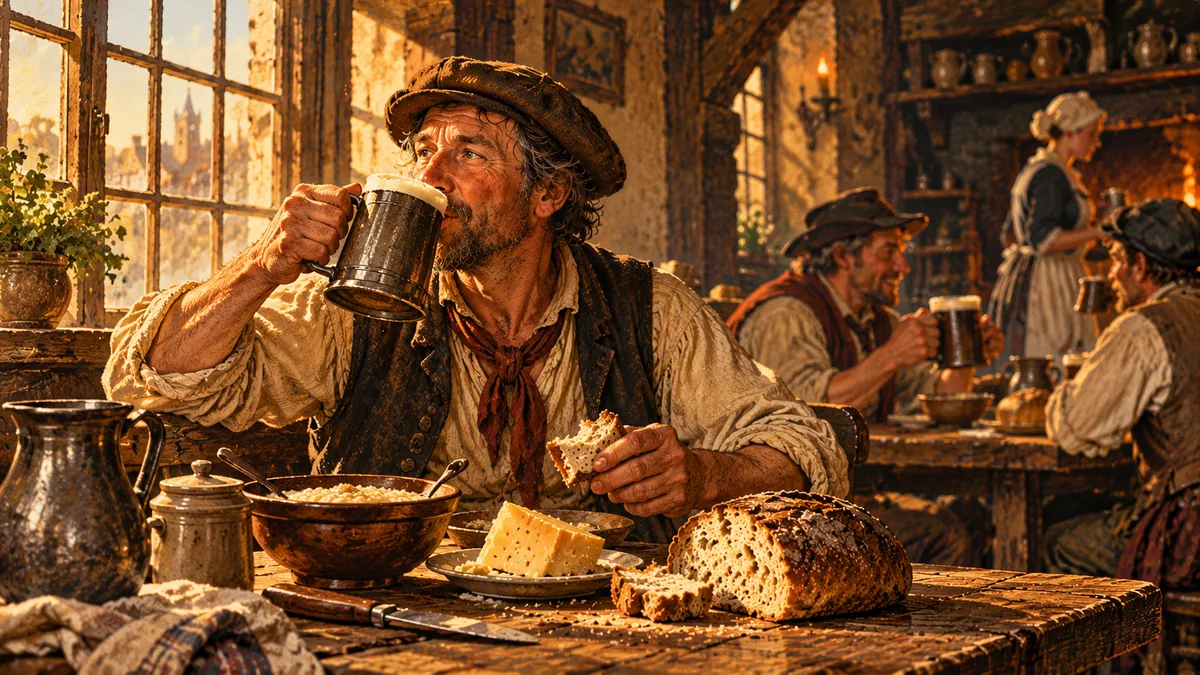
Why did people drink beer for breakfast? For centuries, starting the day with a beer was not necessarily considered strange. In parts of Britain and northern Europe, beer could simply be part of breakfast.
Not because it was Sunday. Not because you were on holiday. And not because you’d already had a particularly bad morning.
Because that was breakfast.
For centuries, beer could appear on the breakfast table in Britain and elsewhere in northern Europe. Workers drank it. Servants drank it. Schoolchildren could be given it.
But before you imagine an entire country stumbling to work drunk before sunrise, there is an important detail.
Some of the beer served for everyday use was small beer — a weaker category of beer — and the story behind it is far more interesting than simply saying that people drank beer because the water was dangerous.
Yes, People Really Did Drink Beer for Breakfast
Why did people drink beer for breakfast? One reason is that beer at breakfast wasn’t just an occasional indulgence. Historical records show that beer formed part of everyday meals.
At Winchester College in England, the school had its own brewhouse. A historical account of the college reports that in 1709 its 70 scholars and 16 choristers were allocated three pints of small beer per day, available at breakfast, dinner and supper. Teachers and servants had larger daily allowances.
This was not unique to schools. Beer was a staple in many early modern households and institutions, and beer allowances could form part of the provisions supplied to workers performing demanding physical labour.
In other words, a morning beer did not necessarily carry the meaning it does today. In some settings, it was simply part of the diet.
What Was Small Beer?
The name sounds almost cute, but “small” did not refer to the size of the glass. It distinguished a weaker, lower-status beer from stronger brews.
Small beer could be produced from a later extraction of malt after richer wort had already been taken for stronger beer. Historical brewing practices varied enormously, however, and there was no single recipe or universal alcohol percentage that defined every small beer.
That distinction matters. Modern research reconstructing a different category — ordinary beer from Dublin Castle in 1574 — produced conditioned beers above 5% ABV, comparable in strength to modern beer. The researchers explicitly warn against assuming that historical beer was necessarily weak.
So when someone says, “Beer used to be basically water,” be suspicious. Some everyday beer was deliberately weak. Other historical beer definitely was not.
Beer Was More Than a Drink
To understand why did people drink beer for breakfast as a historical question, we have to stop thinking of beer only as a modern recreational alcoholic drink.
For many people, beer was also part of the food supply. Grain-based beer provided energy, and early modern sources show it being supplied to labourers as part of their entitlement. A 2023 interdisciplinary study describes beer as a staple of diets across northern Europe and the Atlantic world and as both an intoxicating and energy-providing foodstuff. The Historical Journal study on early modern beer provides detailed experimental and historical evidence.
Consumption could be remarkably high by modern standards. The same research into sixteenth-century Ireland shows that institutional beer allowances and consumption could amount to several pints per person per day.
That does not mean every drinker was consuming the same strength of beer. Beer varied by household, region, season, status and purpose — one reason simple claims about “medieval beer” or “old beer” are so often misleading.
Did Children Really Drink Beer?
They did — although context matters.
Small beer was supplied to children in some households and institutions. The clearest American example comes from George Washington’s Mount Vernon.
Around 1757, the future first U.S. president wrote down a recipe “To make Small Beer” in a notebook he carried as a colonel in the Virginia militia. Mount Vernon’s historians describe small beer as a regular low-alcohol beverage and state that at the estate it was given to paid servants, enslaved people and children, while stronger beer was associated with those who could afford it. Mount Vernon’s surviving small-beer recipe and historical notes provide the primary context for this example.
To modern readers, that sounds astonishing. In its historical setting, it was much less remarkable.
But Wasn’t Beer Safer Than Water?
Here we arrive at one of beer history’s most persistent oversimplifications.
People often repeat some version of this claim: “People drank beer because the water was too dangerous to drink.”
The simple version is wrong. People did drink water, and historical communities invested in wells, springs, conduits and other water supplies. There was never one universal condition in which all water was undrinkable.
But that does not mean the beer-and-water connection is entirely a myth.
Contaminated water was a real danger in some places and periods. Brewing involved heating the brewing liquor, which could reduce exposure to waterborne pathogens even though drinkers did not understand germ theory.
A 2024 study in the Journal of Development Economics examined eighteenth-century England and found that beer scarcity was associated with higher mortality, especially in summer and in places with worse underlying water quality. The authors conclude that beer could represent an improvement over available water sources in that historical setting. Read the Journal of Development Economics study.
So the better answer is nuanced: people did not drink beer because all water was unsafe, but where water was contaminated, beer could unintentionally be the safer option.
The Strange Case of George Washington’s Small Beer
One of the best-known surviving small-beer recipes comes from George Washington.
His circa-1757 recipe used bran, hops, molasses and yeast. The mixture was boiled, cooled, fermented and later bottled.
Its presence in a military notebook supports the idea that small beer was regarded as a practical, ordinary beverage rather than simply a drink for celebration. Mount Vernon’s historians even suggest that it may sometimes have served as a substitute for water among troops.
Washington later preferred stronger beer for his own table. Small beer and stronger beer occupied different places in the drinking culture of his time.
Then Tea Arrived
And this is where the question “why did people drink beer for breakfast?” becomes especially interesting.
Tea reached England in the seventeenth century as an expensive imported luxury, but during the eighteenth century it spread much further through society. Smuggling, changing prices and expanding consumption helped turn it into an increasingly ordinary drink.
The shift was noticeable enough to worry some politicians. Research into eighteenth-century British taxation records Duncan Forbes complaining in the 1740s that poorer people were no longer drinking small beer for breakfast. He blamed cheap, smuggled tea and proposed restricting tea consumption by income. The same research records Joseph Danvers arguing that poorer people should return to beer for breakfast instead of tea.
Imagine that campaign slogan today: PUT THE BEER BACK IN BREAKFAST.
It did not win the long-term battle.
Tea Won the Breakfast War
As tea became more accessible, it increasingly occupied the everyday role once held by other drinks, including beer at breakfast.
And tea brought an accidental public-health advantage of its own: making it required boiling water.
A study published in The Review of Economics and Statistics examined the rise of tea in eighteenth-century England and found larger mortality declines in places with initially poorer water quality as tea consumption spread. The proposed mechanism is straightforward: more tea meant more boiled water. Read the tea and water-quality study.
There is a neat historical symmetry here. Beer could sometimes reduce the danger from contaminated water because brewing involved heat. Then tea — one of the drinks that helped reshape breakfast — brought boiled water into more homes.
The kettle was taking over from the brewhouse.
The Breakfast Beer Didn’t Vanish Overnight
Drinking habits changed gradually, not in a single moment. Beer remained embedded in working life and institutional diets long after tea began spreading.
Over time, however, tea and coffee, changing work patterns, commercial brewing, temperance campaigns, changing attitudes toward alcohol and eventually improved water infrastructure all helped separate beer from the ordinary breakfast table.
Opening a beer in the morning slowly stopped looking like an everyday meal choice. It started looking like drinking.
Why Did People Drink Beer for Breakfast? The Everyday Reasons
So, why did people drink beer for breakfast? There was no single reason.
Beer was deeply embedded in everyday life. Small beer could be an economical, relatively weak household drink. Beer supplied energy, accompanied food and formed part of institutional and workplace provisions. And in some circumstances, brewing could make a drink microbiologically safer than contaminated water.
Most importantly, people did not divide drinks into exactly the same categories we do.
To them, a weak beer with breakfast could be completely unremarkable.
Then tea and coffee spread, water systems changed and drinking culture evolved. The morning beer gradually disappeared from the breakfast table.
Today, millions of people start their morning by boiling water for tea without giving it a second thought. A few centuries ago, in some households, the more familiar breakfast drink might have been beer. For more curious beer history and myths, explore Malt & Myth.
The Malt & Myth Verdict
MYTH: People drank beer for breakfast because water was always unsafe.
REALITY: The answer to “why did people drink beer for breakfast?” is not simply “bad water.” Beer really could be an everyday breakfast drink, including in the form of small beer. Poor water quality could make beer a safer option in some circumstances, but people also drank water. Beer was popular because it was an established part of the diet, supplied energy, accompanied meals and fitted naturally into household and working life.
And one of the drinks that helped push beer away from the breakfast table? Tea.