
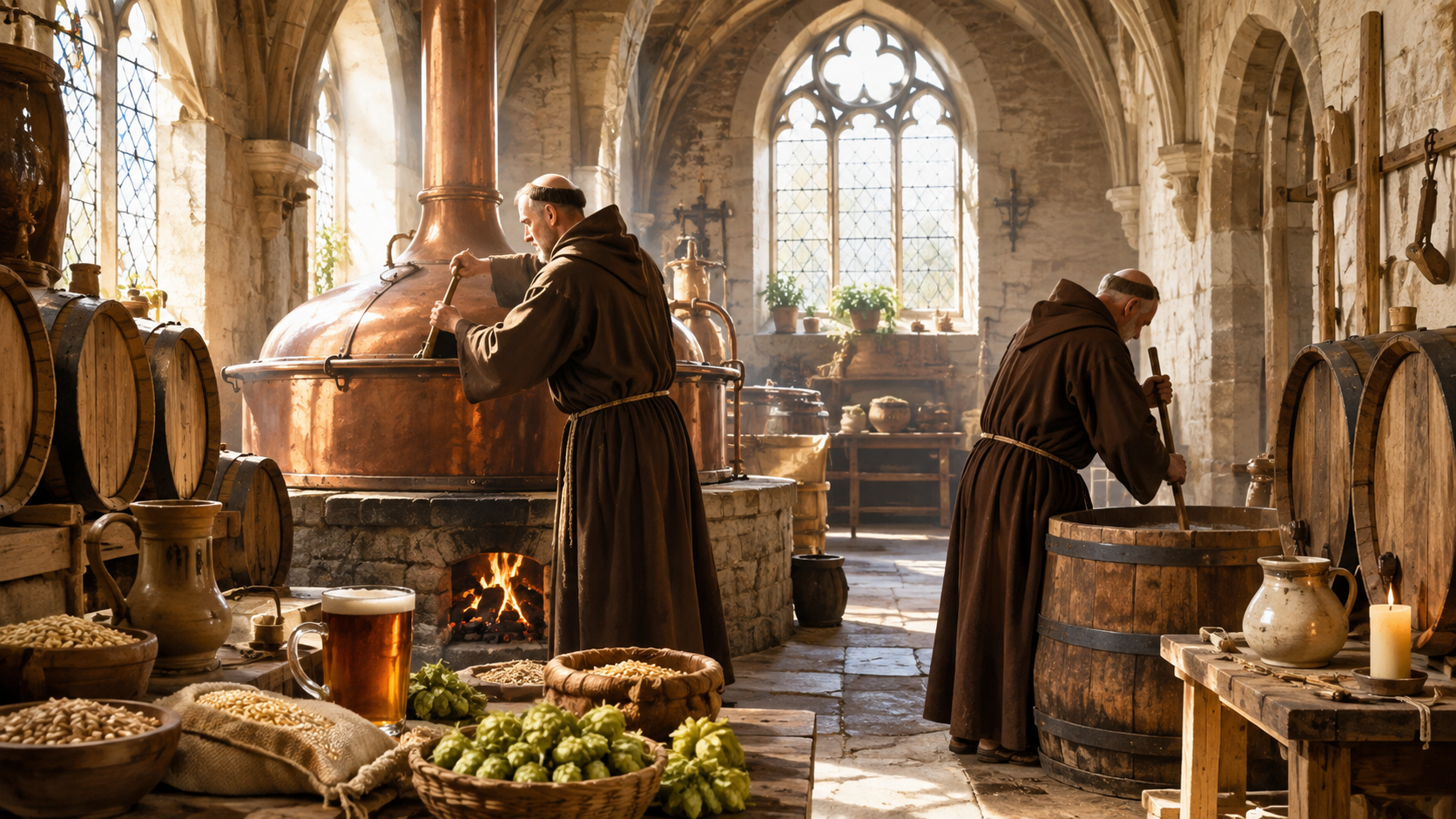
Picture a medieval monastery.
Thick stone walls. Candlelit corridors. Bells marking the hours of the day. Monks copying manuscripts by hand, tending gardens and living according to a strict rhythm of prayer and work.
And somewhere behind those walls, something else is happening.
Beer is being brewed.
Not occasionally. Not secretly. And certainly not simply because a group of medieval monks fancied a drink after evening prayers.
For centuries, monasteries across Europe became important centres of brewing. They produced beer for their own communities, for workers, travellers and guests — and, in some places, eventually for sale.
But the monks did not invent beer.
Humans had been brewing fermented grain drinks for thousands of years before medieval European monasteries appeared.
So why did monks become so closely associated with beer?
And how did monasteries help turn an ancient fermented drink into something that eventually began to resemble the beer we know today?
The answer involves religion, hospitality, agriculture, economics and centuries of accumulated brewing knowledge.
And remarkably, the story isn’t over.
Some monasteries still brew beer today.
First Things First: Monks Did Not Invent Beer
This is probably the most important myth to clear up.
Beer is far older than Christianity.
Archaeological and historical evidence places fermented grain drinks thousands of years before the rise of medieval monasteries. Ancient Mesopotamia and Egypt both had established brewing traditions long before Christian monastic communities spread across Europe.
Even the idea that Western European monks invented hopped beer or large-scale brewing is too simple. Scholarly work on early brewing has challenged both claims, showing that monastic brewing developed within older regional traditions rather than appearing from nowhere behind abbey walls.
What monasteries did exceptionally well was something different.
They organised brewing.
A monastery could function almost like a small, self-contained community. It might control land, grain, water, workshops, kitchens, storage buildings and labour.
More importantly, it had continuity.
Knowledge could be preserved and passed from one generation to the next. That made monasteries unusually good environments for repeating, recording and gradually improving practical processes such as brewing.
Beer wasn’t invented behind monastery walls.
But behind those walls, brewing could become systematic.
Beer Was Part of Everyday Life
To understand why monks brewed beer, you first have to forget the modern idea that beer is primarily something you drink at a bar on Friday night.
In medieval Europe, ale and beer could be part of the everyday diet, particularly in regions where grain-based drinks were common.
Monastic communities had many mouths to feed. There were the monks themselves, but monasteries could also include servants, agricultural workers and craftsmen, while receiving travellers, pilgrims, guests and people in need.
Beer therefore had a practical role. It turned grain into a drink that provided energy as well as flavour, and it fitted naturally into an agricultural economy built around cereals.
In many monasteries the brewhouse was not the medieval equivalent of a fashionable craft brewery. It was closer to part kitchen, part food-production facility and part agricultural workshop.
Beer was simply one of the things a functioning community could produce.
What About the “Beer Was Safer Than Water” Story?
You’ve probably heard this one.
Medieval people drank beer because water was filthy and dangerous.
It’s a great story.
It’s also far too simple.
Medieval people certainly drank water, and communities valued good springs, wells and flowing water. Contamination could be a real problem in some places and at some times, but the idea that ordinary water was universally undrinkable does not fit the historical evidence.
Brewing could have offered some microbiological advantages because heating and fermentation discourage many unwanted organisms. But that does not mean fear of water was the main reason monks brewed.
Beer had plenty of reasons to exist without requiring poisoned medieval wells.
It used locally available grain. It supplied calories. It was part of hospitality. It could be stored and distributed. And people liked drinking it.
Sometimes the simplest explanation is surprisingly familiar:
Beer was useful — and beer was good.
A Monastery Was Almost Perfect for Brewing
Now we get to the part where monks really mattered.
Brewing benefits enormously from consistency.
You need ingredients. You need equipment. You need storage. You need time. And if you want to improve your beer, you need to remember what worked last time.
Monasteries were unusually well suited to all of those things. Many monastic communities managed substantial agricultural estates and organised specialised spaces for food production and storage.
One extraordinary piece of evidence is the famous Plan of Saint Gall, drawn in the early ninth century as an ideal model for a Benedictine monastic complex.
The plan includes dedicated bake-and-brew areas serving different parts of the imagined monastery community, including monks, guests, pilgrims and the poor.
That point matters: the plan was an ideal design, not proof that the Abbey of Saint Gall itself operated the depicted breweries exactly as drawn.
But it still tells us something important.
Brewing was important enough to be planned into the organisation of a major monastic complex.
It wasn’t an afterthought.
Prayer, Work — and Brewing
A phrase often associated with monastic life is ora et labora: prayer and work.
Whatever the exact wording, manual labour and self-support were central parts of many monastic traditions. Brewing fitted naturally into that world.
Grain grown or acquired by a monastery could become beer. The beer could supply the community and its guests. In some places, surplus production could also be sold.
Over time, brewing therefore became more than a household activity at certain monasteries. It became an economic one.
Income from monastic industries helped communities maintain buildings, support their members and fund hospitality or charitable work.
That basic principle still survives in modern Trappist brewing. But we’ll come back to that.
The Monks and the Rise of Better Beer
It would be easy to imagine medieval monks wearing robes and experimenting like modern brewing scientists.
Reality was probably less dramatic.
There was no stainless-steel brewhouse. No digital temperature controller. No laboratory measuring yeast health.
But repeated brewing creates knowledge.
If one batch spoils and another doesn’t, eventually someone notices. If one ingredient improves flavour or keeping quality, that matters. If certain storage methods work better, they can be repeated.
Monasteries could exist across generations, sometimes for centuries. That gave them something extremely valuable: institutional memory.
Techniques, recipes and agricultural practices could survive individual brewers. Religious networks also connected communities across regions, allowing people and knowledge to travel.
This did not mean every monk was a master brewer, or that monasteries alone drove brewing innovation.
But they created conditions in which brewing knowledge could accumulate.
Slowly. Batch after batch. Century after century.
And Then There Were Hops
Today, hops seem inseparable from beer.
But that wasn’t always the case.
European brewers historically used many different herbs and plants to flavour fermented grain drinks. Hops gradually became increasingly important because they contribute bitterness, aroma and preservative effects.
Monasteries appear in the written history of hops surprisingly early.
Weihenstephan’s own historical account cites a document from 768 referring to a hop garden near the monastery whose owner owed a tithe to the monastery.
That does not prove that monks invented hopped beer — and it does not even prove exactly how those particular hops were used.
But it does show how closely monasteries, agriculture and brewing ingredients could become connected.
Over the following centuries, hopped beer increasingly displaced many older herbal traditions across large parts of Europe.
The flavour of European beer was changing.
Monasteries were part of that story, not the beginning of it.
The Brewery That Claims Nearly 1,000 Years of History
If you want to see how long the connection between monasteries and brewing can last, look at Weihenstephan in Bavaria.
The brewery’s official history says a Benedictine monastery was founded on Weihenstephan Hill in 725 and dates the formal beginning of its brewery to 1040, when Abbot Arnold is said to have obtained the right to brew and sell beer.
Today, the Bavarian State Brewery Weihenstephan describes itself as the world’s oldest existing brewery.
The famous 1040 date is part of the brewery’s traditional history, but historians have questioned how securely that specific claim can be documented. It is therefore better treated as a traditional founding date than as an uncontested fact.
The monastery itself was dissolved during secularisation in 1803.
The brewery survived and passed into Bavarian state ownership. It still operates on Weihenstephan Hill today.
So while monks no longer brew Weihenstephan beer, the brewery remains a striking descendant of Europe’s monastic brewing tradition.
Few drinks connect the medieval and modern worlds quite so neatly.
But Some Monks Really Do Still Brew Beer
This is where the story becomes particularly interesting.
Monastic brewing did not disappear with the Middle Ages.
It still exists.
The most famous modern example is Trappist beer.
And “Trappist” does not describe one beer style. It describes a monastic origin and a protected tradition.
The International Trappist Association sets strict conditions for products carrying its Authentic Trappist Product label.
The product must be made within the immediate surroundings of the abbey. Production must take place under the supervision of monks or nuns. And profits are intended for the needs of the monastic community, solidarity within the order, development projects or charitable works.
That last part matters.
A genuine Trappist brewery is not simply a commercial brewery using monks as branding.
The brewery exists within the economic life of a living monastic community.
It’s a modern continuation of an idea that goes back centuries.
The Trappist Breweries Still Carrying the Tradition
As of 2026, the International Trappist Association still lists a number of abbeys that brew and sell their own Trappist beer.
Belgium remains the best-known centre of the tradition. Chimay, Orval, Rochefort, Westmalle and Westvleteren are all still represented.
The Netherlands has La Trappe. Italy has Tre Fontane. Britain has Tynt Meadow from Mount Saint Bernard Abbey. The association’s broader list also includes other abbeys connected with Trappist beer production.
Each brewery has its own history and its own beer.
There is no single “Trappist recipe.”
A dark, powerful Rochefort and the distinctive dry, bitter character of Orval can both be Trappist beers while tasting completely different.
What connects them isn’t flavour.
It’s the monastery and the rules surrounding production.
Orval: A Medieval Idea in a Modern Brewery
Orval in Belgium provides a perfect example of how the tradition works today.
The modern Orval brewery was created inside the abbey in 1931 to help finance the enormous reconstruction of the monastery.
Interestingly, lay workers have been employed in the brewery from the beginning, including its first master brewer.
That exposes another misconception.
“Brewed by monks” does not necessarily mean monks personally perform every physical task in the brewhouse.
The important point is that production takes place at or around the monastery and remains under the supervision and authority required by the Trappist rules.
Orval says part of the revenue from its products goes to charity, while royalties help support social welfare work and the maintenance of the abbey buildings.
The brewery also deliberately describes its growth as controlled rather than unlimited.
Demand may say: make more.
The monastery can still say: enough.
There may be no better illustration of the difference between monastic brewing and ordinary commercial brewing.
From Monastery Table to Beer Legend
Another fascinating survival is the tradition of table beer.
Not every beer made for monks was intended to be strong.
Westmalle in Belgium still produces Westmalle Extra, a golden Trappist beer at 4.8% alcohol by volume.
For a long time it was primarily consumed by the monks and their guests during meals. Only in recent years has it been distributed more widely through the beer trade and hospitality industry.
Think about that for a moment.
While beer enthusiasts around the world chased powerful Belgian Trappist ales, the monastery’s own table included a relatively modest beer made for everyday drinking with food.
That may actually bring us closer to one important side of historical monastic beer: beer not as a luxury object, but as part of daily life.
And at One Abbey, the Monks Still Do the Brewing
Mount Saint Bernard Abbey in England makes the connection even more tangible.
The community installed a small artisanal brewery in 2017–18 after its previous agricultural work was no longer sufficient to support the abbey.
Its beer, Tynt Meadow, became Britain’s first Trappist beer.
The abbey says brewing is now its principal field of labour and that the work — from brewing to bottling and packaging — is done by the monks themselves.
Production is intentionally kept relatively small: enough to meet the abbey’s expenses and support its charitable commitments.
So the image of monks physically making beer is not merely medieval nostalgia.
In at least some monasteries, it is still happening now.
So Did Monks Create Modern Beer?
No.
But they helped shape its history.
Beer existed long before monasteries. Hops were not invented by monks. Brewing was not invented by monks. And medieval Europeans did not spend their lives drinking beer because every glass of water would kill them.
The real story is more interesting.
Monasteries provided stable communities where agriculture, brewing, craftsmanship, hospitality and economic organisation could exist together for long periods of time.
They preserved and developed brewing traditions. They operated organised brewhouses. They grew, bought and used brewing ingredients. In some places they sold beer to support the community.
And certain monastic brewing traditions proved strong enough to survive wars, fires, political upheaval, secularisation and the rise of industrial brewing.
Some survived all the way into the twenty-first century.
A Thousand Years in a Glass
The next time you pour a Trappist beer, look at it for a second before drinking.
That glass represents something unusual.
Not an unchanged medieval recipe.
Not a beer frozen in time.
Something much more interesting.
A living tradition.
The equipment has changed. The science has changed. The bottles have changed. The world outside the monastery walls has changed almost beyond recognition.
But the underlying idea remains remarkably familiar.
Produce something useful. Produce it well. Use the work to sustain the community. And do not necessarily produce more simply because the market would buy more.
More than a thousand years after monasteries became important centres of European brewing, monks are still connected to beer.
Not because they invented it.
But because they became some of its most persistent guardians.
And somewhere today, behind the walls of a quiet abbey, another batch is still fermenting.
The monks are still brewing.