
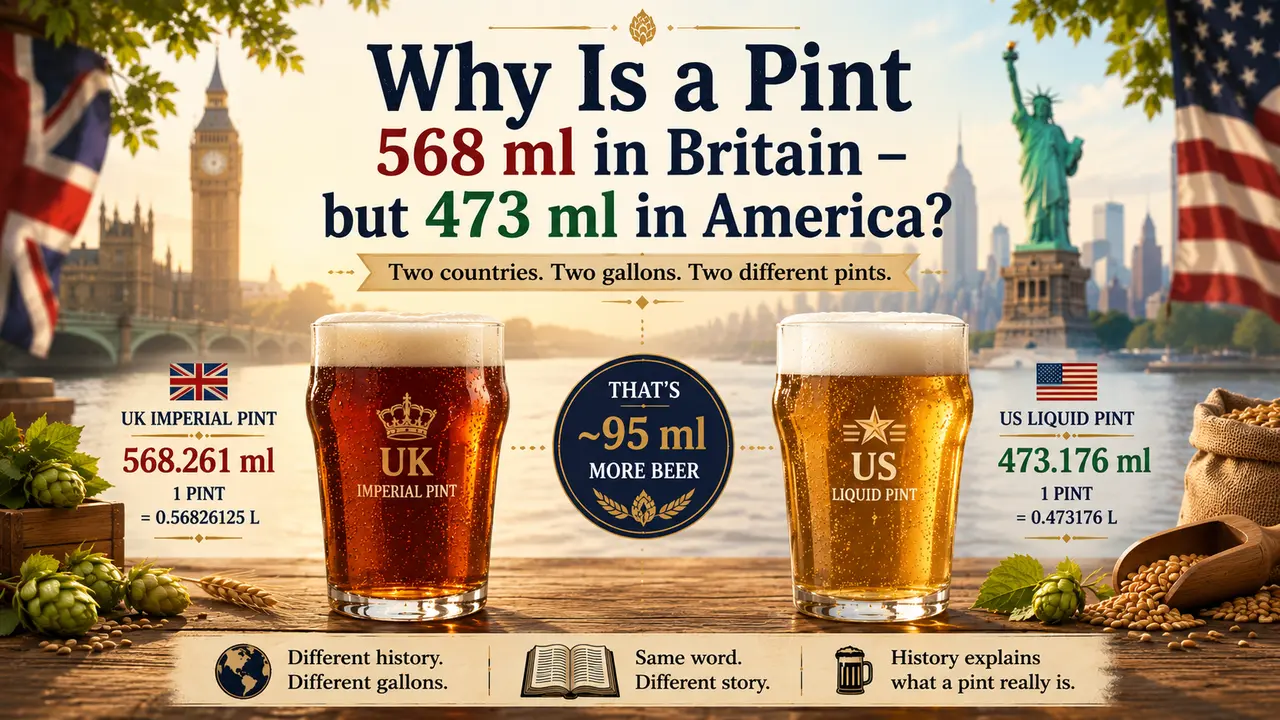
Walk into a pub in London and order a pint of beer. Then do the same thing in New York.
You might expect the same amount of beer. After all, a pint is a pint.
Except it isn’t.
A British imperial pint contains 568.261 millilitres. An American liquid pint contains only about 473.176 millilitres.
That is a difference of roughly 95 millilitres — enough to be noticeable when the glasses are placed side by side.
So what happened?
Did Americans shrink the pint? Did Britain make theirs larger? Or is one country simply using the measurement incorrectly?
The answer takes us back hundreds of years, to a time when gallons were not nearly as simple as they sound today.
And, as is often the case with beer history, the familiar explanation hides a much stranger story.
A Pint Is Only as Big as Its Gallon
The first thing to understand is that the pint was never really an independent measurement.
Traditionally, a pint is one eighth of a gallon.
That sounds simple enough.
The problem is that for much of history there was no single universal gallon.
Different gallons existed for different products. Wine could be measured using one gallon, ale using another, and dry goods using yet another.
England inherited a complicated collection of measurements that had developed over centuries of trade, taxation and local practice.
The names might sound familiar — gallon, quart, pint — but the actual quantities behind those names were not always the same.
That matters because if the gallon changes, everything below it changes too.
A gallon contains four quarts.
A quart contains two pints.
So a gallon contains eight pints.
Change the gallon and you automatically change the pint.
That simple fact is the reason an American pint and a British pint are different today.
Before the Imperial Pint
Long before Britain created the imperial system, English merchants were already using several measures called gallons.
One particularly important example was the wine gallon.
By the early eighteenth century, the English wine gallon had been established at 231 cubic inches. This was used for wine and other liquids and eventually became extremely important on the other side of the Atlantic.
Beer and ale, meanwhile, had historically been associated with other measures.
In other words, someone buying a gallon of one commodity could potentially be talking about a different physical volume than someone buying a gallon of another.
To modern eyes, that sounds chaotic.
But before standardized industrial production, international logistics and precision manufacturing, measurement systems often developed in exactly this way.
They were products of custom rather than carefully designed systems.
The American colonies inherited these English measurements.
Then came independence.
And that is where the paths began to split.
America Keeps an Older English Gallon
After the United States became independent, it did not suddenly invent an entirely new measurement system.
Many familiar English units continued to be used.
One of them was the old 231-cubic-inch wine gallon.
The American colonists had already used this measure, and it remained deeply embedded in trade and everyday life.
The 231-cubic-inch wine gallon remained the basis of US liquid measure and was later adopted as the standard US gallon.
Despite its English origins, this is not an imperial pint. The Imperial System did not yet exist when the American measurement tradition began to diverge from Britain’s.
That gallon is still essentially the American gallon we know today.
One US liquid gallon equals approximately 3.785 litres.
Divide it by eight and you get the American liquid pint:
473.176 millilitres.
So the modern American pint is not a reduced version of the British pint.
In a historical sense, it is the descendant of an older English measure.
That is the first great twist in the story.
America did not take Britain’s modern pint and make it smaller.
America kept using a measurement whose roots went back to Britain before the modern British pint even existed.
Britain Changes the Rules
While the United States continued down one path, Britain eventually decided that its collection of different measures needed reform.
The major reform came with the Weights and Measures Act 1824, which took effect in 1825.
The legislation attempted to create a more uniform system and introduced what became known as the imperial gallon.
Instead of continuing with the older wine gallon, Britain established a new gallon linked to the volume occupied by ten pounds of distilled water under specified conditions.
The new imperial gallon was significantly larger than the old wine gallon used in America.
The imperial gallon eventually became fixed at approximately 4.546 litres.
And because a pint remained one eighth of a gallon, Britain also got a new, larger pint.
One imperial pint became:
568.26125 millilitres.
Britain had effectively changed the gallon — and the pint changed with it.
From that point onward, Britain and the United States could both use words such as gallon, quart and pint while meaning different amounts.
The Same Words, Two Different Systems
This is what makes the situation so confusing.
The British imperial system and the US customary system look closely related.
Both have inches.
Both have feet.
Both have pounds.
Both have gallons.
Both have pints.
But shared names do not always mean shared quantities.
With liquid volume in particular, the divergence is substantial.
A US liquid gallon is about 3.785 litres.
A British imperial gallon is about 4.546 litres.
A US liquid pint is therefore about 473 ml.
A British imperial pint is about 568 ml.
That makes the imperial pint roughly 20 percent larger than the US liquid pint.
And there is another small complication.
The fluid ounces themselves are different too.
An American pint contains 16 US fluid ounces.
An imperial pint contains 20 imperial fluid ounces.
But an imperial fluid ounce is slightly smaller than an American fluid ounce.
It is one of those measurement systems that becomes less intuitive the more closely you look at it.
Still, the important part is simple:
The two countries inherited a common measurement tradition, then standardized it differently.
So Did Britain Make the Pint Bigger?
In practical terms, yes — but that statement can also be misleading.
The British imperial pint introduced in the nineteenth century was larger than the pint derived from the older wine gallon retained by the United States.
But saying that Britain simply “made the pint bigger” removes the historical context.
Britain was trying to replace multiple competing capacity measures with a unified imperial system.
The United States, meanwhile, had already inherited and continued using another branch of the older English measurement tradition.
Neither country woke up one morning and deliberately decided that its beer drinkers deserved more or less beer.
The difference is a historical accident created by two countries standardizing related measurement systems at different times.
And it survived.
How the Pint Became a Beer Icon
Technically, a pint is simply a unit of volume.
Culturally, it became something much bigger.
Especially in Britain and Ireland, “a pint” became almost inseparable from pub culture.
You do not necessarily say that you are going out to consume 568 millilitres of beer.
You “go for a pint.”
The unit became a social expression.
A pint could mean the drink, the glass, the occasion and even the act of going to the pub.
That connection became strong enough to survive Britain’s wider transition toward metric measurements.
Today, most goods in Britain are sold using metric units.
But draught beer and cider remain notable exceptions.
British regulations still permit them to be sold by the imperial pint.
In other words, while kilograms, litres and millilitres dominate modern British commerce, the pint still holds its ground at the pub.
Few units of measurement have such a powerful cultural defence.
A British Pint Is a Real Defined Quantity
In Britain, ordering a pint of draught beer is not merely ordering “a fairly large glass.”
The pint is a defined unit.
Current UK legislation defines a pint as 0.56826125 cubic decimetres, equivalent to 568.26125 ml.
Rules also specify the quantities in which draught beer and cider may be sold.
These include one third of a pint, one half, two thirds and multiples of half a pint.
That gives the word “pint” a very specific meaning in a British pub.
The glass itself may have different shapes depending on the beer, brewery or venue, but the measurement does not change simply because the glass design does.
This is important because elsewhere the word pint can sometimes be used much more loosely.
The American Pint Glass Problem
In the United States, the term “pint glass” often refers to the familiar 16-ounce shaker glass.
Its association with the word pint can make it easy to assume that every beer served in one automatically contains a full American pint.
But a glass with a nominal 16-ounce capacity does not necessarily mean that every serving contains a full 16 fluid ounces of liquid, especially when space is left for foam.
This creates an interesting situation for travellers.
An American visiting Britain may receive considerably more beer than expected when ordering “a pint.”
A British visitor to the United States may have the opposite reaction.
Same word.
Different measurement.
Different history.
What Happens in the Rest of the World?
Most countries have moved toward metric measurements, so beer is commonly sold in millilitres or litres rather than formal pints.
That makes life much easier mathematically.
A 330 ml bottle is 330 ml.
A 500 ml beer is 500 ml.
There is no need to ask which country’s gallon is hiding behind the measurement.
But the word pint has travelled far beyond the places where it remains a formal unit.
Bars around the world may describe certain glasses or servings as pints, sometimes because of British or American influence and sometimes simply because customers recognize the term.
That does not necessarily mean every “pint” encountered internationally contains exactly 568 ml or exactly 473 ml.
The word has become cultural as well as mathematical.
And that is perhaps the strangest part of the whole story.
A centuries-old family of measurements has survived into a world otherwise dominated by litres and millilitres — largely because people still like ordering beer with it.
There Is Even More Than One American Pint
As if the story were not complicated enough, the United States technically has another pint.
The familiar US liquid pint is approximately 473 ml.
But American dry measurement also has a dry pint, which is larger — approximately 551 ml.
You are unlikely to encounter a dry pint when ordering beer, of course.
But its existence perfectly illustrates the historical problem.
Words such as pint were never created as part of the neat, decimal measurement system we expect today.
They evolved through centuries of trade and custom.
Their meanings depended on what was being measured, where it was being measured and which legal standard happened to apply.
Which Country Has the “Real” Pint?
It is tempting to declare a winner.
Britain has the larger pint, so perhaps that must be the real one.
Or perhaps America has the older direct connection to the English wine gallon, giving it the stronger historical claim.
Neither argument really works.
There is no single ancient pint from which every later pint can be judged.
Historically there were multiple gallons and therefore multiple pints.
The modern British and American versions are simply different surviving branches of that complicated family tree.
The American liquid pint comes from a gallon based on the old English wine gallon of 231 cubic inches.
The British imperial pint comes from the imperial gallon created during the nineteenth-century reform of British weights and measures.
Both are genuine units.
Both have historical roots.
They just are not the same size.
Nearly 100 Millilitres of History
Today the difference between the two pints seems almost absurd.
We can define a millilitre precisely anywhere on Earth.
Yet someone can still order “one pint” in two English-speaking countries and receive quantities differing by almost 100 millilitres.
But that difference is not a mistake.
It is history preserved in glass.
The United States carried an older English liquid measure into its own system.
Britain later replaced its collection of older gallons with the imperial gallon.
Each country kept dividing its gallon into eight pints.
And two centuries later, beer drinkers are still living with the result.
So the next time someone tells you that a pint is a pint, there is one obvious question to ask:
Which pint?
Because sometimes the difference between two beers is not the brewery, the recipe or the glass.
Sometimes it is two hundred years of measurement history.