
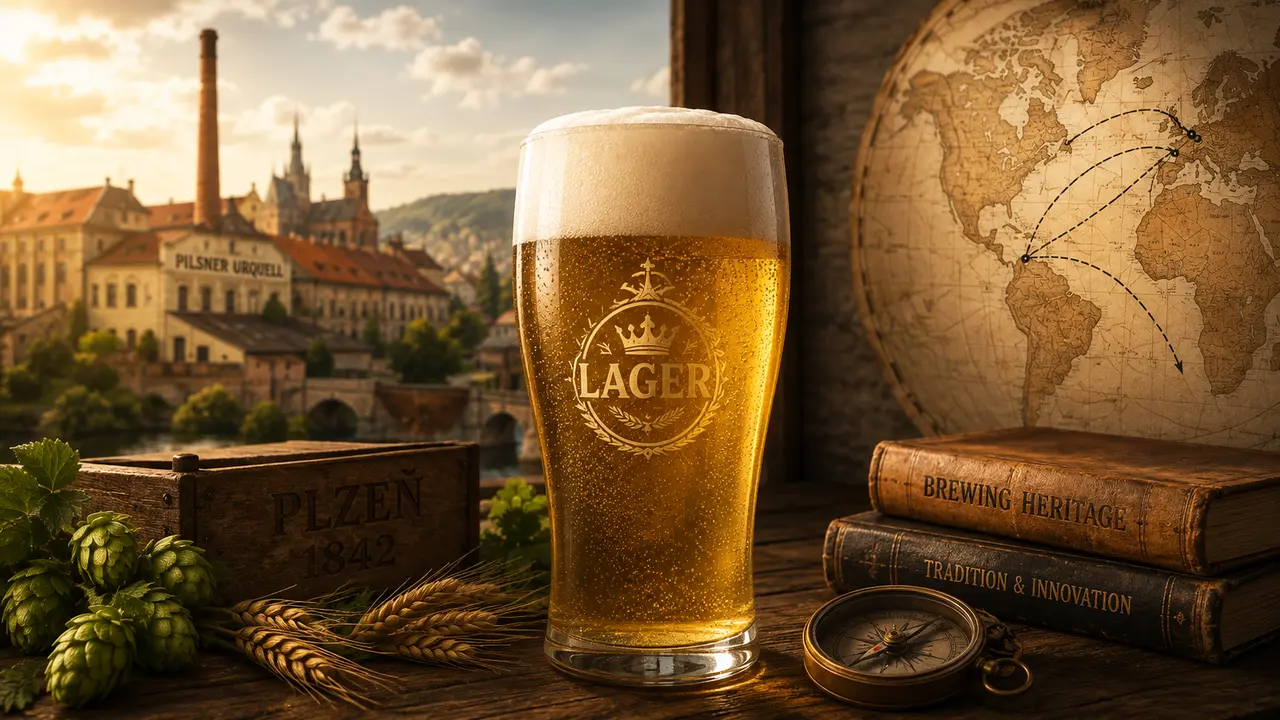
Malt & Myth — Series 006
Walk into almost any bar, supermarket or stadium in the world and there is a good chance that the most familiar beer in sight belongs to the same broad family.
Lager.
It may be pale gold or deep amber. It may come from Prague, Munich, Copenhagen, Mexico City, Tokyo or Milwaukee. It may carry the name of a centuries-old European brewery or a global brand sold across continents.
But lager was not always the default beer of the world.
For most of brewing history, it wasn’t even possible to make it the way we do today.
The rise of lager is not the story of one brewer inventing a new beer. It is a much bigger story — one involving cold caves, an unusual yeast, a revolutionary beer in Bohemia, railways, glassware, refrigeration and science.
Together, they transformed beer.
And eventually, lager conquered the world.
Before Lager Ruled Beer
Humans had been brewing beer for thousands of years before anything resembling modern lager appeared.
Most traditional European beers were fermented relatively warm with yeasts associated with what we now call ale brewing. Fermentation was not understood scientifically. Brewers knew how to make beer because generations before them had learned what worked.
Yeast itself remained mysterious.
Then brewers in parts of Central Europe began doing something different.
They fermented and stored beer in cool conditions.
Bavaria became particularly important to this tradition. Cold cellars and caves offered brewers naturally low temperatures, and beer could be stored there for extended periods.
The German word lagern means to store.
That gives us the name.
But lager was not simply an ale placed in a cold cellar.
A different kind of yeast became central to the process.
The Yeast Built for the Cold
Modern lager fermentation is associated with Saccharomyces pastorianus.
And this yeast has a remarkable history.
It is a hybrid containing genetic material from two different yeast species: Saccharomyces cerevisiae, familiar from ale fermentation, and the cold-tolerant Saccharomyces eubayanus.
That combination gave lager yeast an important advantage.
It could perform well at temperatures where ordinary ale yeasts struggled.
Exactly where and when the hybrid first emerged remains an active area of historical and genetic research. Recent work has proposed that the crucial hybridisation may have occurred in Munich around the beginning of the seventeenth century, although bottom fermentation itself had been practised in parts of Bavaria much earlier.
The important point is that lager was not suddenly invented on one particular afternoon.
It developed gradually from Central Europe’s tradition of cold brewing.
For centuries, however, cold was also lager’s great limitation.
Brewers could dig cellars and fill them with winter ice. They could brew during the colder months.
What they could not do was control temperature whenever and wherever they wanted.
That would become important later.
First, lager needed a beer that would make the world pay attention.
Then Came Pilsen
In the early nineteenth century, the citizens of Plzeň — Pilsen in German — were unhappy with their beer.
The city was in Bohemia, now part of the Czech Republic, and had a long brewing tradition. But local beer quality had become a problem.
The city’s burghers decided to build a new brewery.
And they looked toward Bavaria for expertise.
They hired a Bavarian brewer named Josef Groll.
Groll brought cold-fermentation knowledge to a place with an unusually useful combination of brewing ingredients and technology.
Plzeň had remarkably soft water.
The region had access to aromatic Saaz hops.
Advances in malting made it possible to produce much paler malt than had traditionally been common in Central European lager brewing.
Groll combined these elements with bottom fermentation.
In 1842, the result appeared.
It was clear.
It was golden.
And it looked dramatically different from many of the darker beers people were accustomed to drinking.
The beer became known as Pilsner.
The original survives today as Pilsner Urquell — essentially, the “original source” of Pilsner.
Groll did not invent lager. Bottom-fermented beer had existed for centuries, and Anton Dreher had already developed his influential Vienna lager shortly before Pilsner appeared. What emerged in Plzeň in 1842 was something distinct: the brilliantly golden beer that established the Pilsner tradition.
What happened in Plzeň was nevertheless extraordinary.
Pilsner provided a template that would become one of the most influential designs in brewing history.
Beer Suddenly Looked Beautiful
Taste was only part of Pilsner’s advantage.
It arrived at an unusually good moment.
During the nineteenth century, improvements in industrial glassmaking made drinking glasses increasingly affordable and widespread.
That mattered.
A dark beer served in an opaque ceramic mug hides much of its appearance.
Pilsner wanted to be seen.
Through clear glass, drinkers could see its brilliant golden colour, its clarity and its white foam.
Beer had acquired visual appeal in a new way.
Glassware complemented Pilsner’s striking appearance, even if it was only one part of the beer’s wider rise.
And another nineteenth-century revolution was happening at the same time.
The railway.
Lager Gets on a Train
Beer had traditionally been a strongly local product.
Transport was slow. Beer could spoil. Moving large quantities over long distances was difficult and expensive.
Railways began changing that.
Pilsner could travel beyond Plzeň.
Its reputation spread through the Austro-Hungarian Empire and into cities including Vienna, Berlin and Paris. Other brewers noticed what was happening.
And they began making their own versions.
The name of one Bohemian city started turning into the name of an entire style.
Pilsner.
Pils.
Pilsener.
By the second half of the nineteenth century, lager was no longer simply a regional Central European brewing tradition.
It was becoming an international phenomenon.
But one major obstacle remained.
Lager needed cold.
The Machine That Freed Lager From Winter
For generations, lager brewers had depended on climate.
Cold winters produced ice.
Ice kept cellars cool.
Cool cellars allowed lager fermentation and maturation.
A warm year could create problems. A warm country created even bigger ones.
Mechanical refrigeration changed the equation.
German engineer Carl von Linde developed practical refrigeration technology during the nineteenth century, with brewing becoming one of its important early industrial applications.
Breweries no longer had to depend entirely on winter ice and naturally cold caves.
Temperature could increasingly be controlled.
That changed the geography of lager.
A brewing method shaped by the climate of Central Europe could now travel to places where nature had never provided ideal lagering conditions.
It also changed the calendar.
Lager brewing was no longer tied as closely to the cold months.
Breweries could produce beer more consistently and on a much larger scale.
The cold cellar had become industrial technology.
And lager was ready to travel.
Science Enters the Brewery
There was still another problem.
Brewing remained biologically unpredictable.
Brewers reused yeast from one fermentation to start another, but microorganisms were poorly understood. Unwanted yeast and bacteria could contaminate beer and create strange flavours or ruin entire batches.
Then brewing science took a major step forward in Copenhagen.
At the Carlsberg Laboratory, scientist Emil Christian Hansen developed a method for isolating and propagating pure yeast cultures.
In 1883, a purified yeast culture was successfully used for production at Carlsberg.
The consequences were enormous.
Instead of relying on mixed and potentially unpredictable cultures, brewers could work with selected yeast strains and reproduce results far more consistently.
Hansen’s pure-culture method spread through the brewing industry, helping breweries achieve far greater consistency.
Combined with refrigeration, improved sanitation and increasingly sophisticated industrial equipment, it helped transform brewing from a craft dependent heavily on local conditions into a process that could be repeated reliably on enormous scales.
Lager was becoming an industrial beer perfectly suited to an industrial age.
Lager Crosses the Atlantic
Millions of Europeans emigrated during the nineteenth century.
They carried their drinking traditions with them.
German and Central European immigrants helped establish lager brewing in the United States, where the style increasingly competed with the ales that had dominated earlier brewing traditions.
America provided fertile ground.
Growing cities created enormous markets.
Railroads connected them.
Industrial refrigeration helped breweries expand.
Mass-produced bottles and later improved packaging allowed beer to travel farther.
Large breweries developed regional and eventually national distribution networks.
The lager brewery became a factory capable of producing huge quantities of remarkably consistent beer.
Similar transformations were happening elsewhere.
Lager brewing spread through Europe and then much farther.
The style adapted as it travelled.
The Lager That Conquered the World Wasn’t Exactly Pilsner
This is where the story becomes more complicated.
The beers inspired by Pilsen did not remain identical to Pilsner Urquell.
Brewers adjusted recipes to local ingredients, water, tastes, taxes and economics.
Some became lighter.
Some became less bitter.
Different grains were sometimes used alongside barley.
The broad family of pale lager gradually expanded into many regional forms.
German Pils became distinct from Czech Pilsner.
Munich developed Helles.
Export lagers evolved.
American lager developed its own character.
Breweries in Asia, Africa, Latin America and elsewhere created local interpretations.
Eventually, the pale international lager emerged — light-coloured, highly drinkable, consistent and designed for broad appeal.
It was not simply Pilsner Urquell copied around the planet.
It was the result of generations of adaptation.
But the family resemblance remained.
Golden colour.
Cold fermentation.
Clean flavour.
Bright clarity.
A crisp finish.
The visual language of beer had changed.
Why Lager Won
There was no single reason.
Instead, lager arrived at the intersection of several enormous changes.
Cold fermentation produced flavours many drinkers found clean and refreshing.
Pale malt made brilliant golden beer possible.
Pilsner demonstrated just how attractive that beer could be.
Glassware helped showcase its appearance.
Railways carried it to new markets.
Mechanical refrigeration allowed it to be brewed regardless of season and climate.
Pure yeast cultures made production more reliable.
Industrial brewing allowed enormous volumes to be produced consistently.
Migration and global trade carried brewing traditions around the planet.
And then success created more success.
As large breweries grew, lager became increasingly familiar. Drinkers came to expect beer to look pale, clear and golden.
In many countries, that image eventually became almost synonymous with beer itself.
Ask someone who knows nothing about beer to draw a glass of it, and there is a good chance they will colour it gold.
That is lager’s cultural victory.
The Beers Lager Didn’t Kill
Lager’s rise was enormous, but it never erased every other brewing tradition.
Britain retained powerful ale traditions.
Ireland remained famous for stout.
Belgium preserved an extraordinary range of top-fermented beers.
Germany itself kept regional styles such as Kölsch, Altbier and wheat beer alongside lager.
And in recent decades, the modern craft beer movement has revived and reinvented countless ale styles.
India pale ale returned with extraordinary force.
Stout survived.
Sour beer returned to attention.
Belgian styles found new audiences around the world.
Ironically, lager itself has now been rediscovered by many craft brewers.
After decades in which “lager” could be dismissed by enthusiasts as shorthand for mass-produced beer, brewers have returned to Czech lager, German Pils, Helles, Kellerbier and other traditional forms with renewed respect.
Because lager was never inherently simple.
Good lager is extremely demanding to make.
Its clean profile leaves little room for mistakes.
Lager Wasn’t Invented. It Evolved.
Perhaps the biggest myth in lager’s story is the desire to find one inventor.
There isn’t one.
Josef Groll deserves an important place in brewing history, but lager existed before him.
Carl von Linde did not invent lager either. He made controlled cold brewing far easier.
Emil Christian Hansen did not create lager yeast. He helped brewers isolate and propagate pure cultures reliably.
Pilsner did not single-handedly conquer the planet.
Neither did refrigeration.
Neither did railways.
Lager conquered the world because all these developments connected.
Centuries of cold brewing created the foundation.
A hybrid yeast adapted to those conditions.
Pilsner gave lager an irresistible new appearance.
Industrialisation gave breweries scale.
Railways gave them reach.
Refrigeration freed them from climate.
Microbiology gave them consistency.
Global migration gave them new markets.
One breakthrough would not have been enough.
Together, they changed what the world expected beer to be.
The Golden Legacy
Today, lager exists at almost every level of brewing.
There are enormous international brands producing millions of hectolitres.
There are tiny breweries patiently lagering beer for weeks.
There are Czech pubs pouring traditional pale lager beneath thick caps of foam.
There are Bavarian beer halls serving Helles by the litre.
There are Mexican lagers, Japanese lagers, American lagers and countless local interpretations across the world.
They are descendants of a brewing tradition that once depended on winter temperatures and cold underground cellars.
That may be the most remarkable part of the story.
Lager began as a beer constrained by geography and climate.
Technology removed those constraints.
Science made the process more predictable.
Industry gave it scale.
And drinkers did the rest.
The result was not simply another beer style.
It became, for billions of people, what beer looks like.
Leave a Reply