
The tiny 1892 invention that changed bottled beer forever
You’ve probably opened thousands of beer bottles with a crown cap.
A quick pull with a bottle opener. A metallic pop. The cap lands on the table.
And you never think about it again.
But look closely at the beer bottle crown cap.
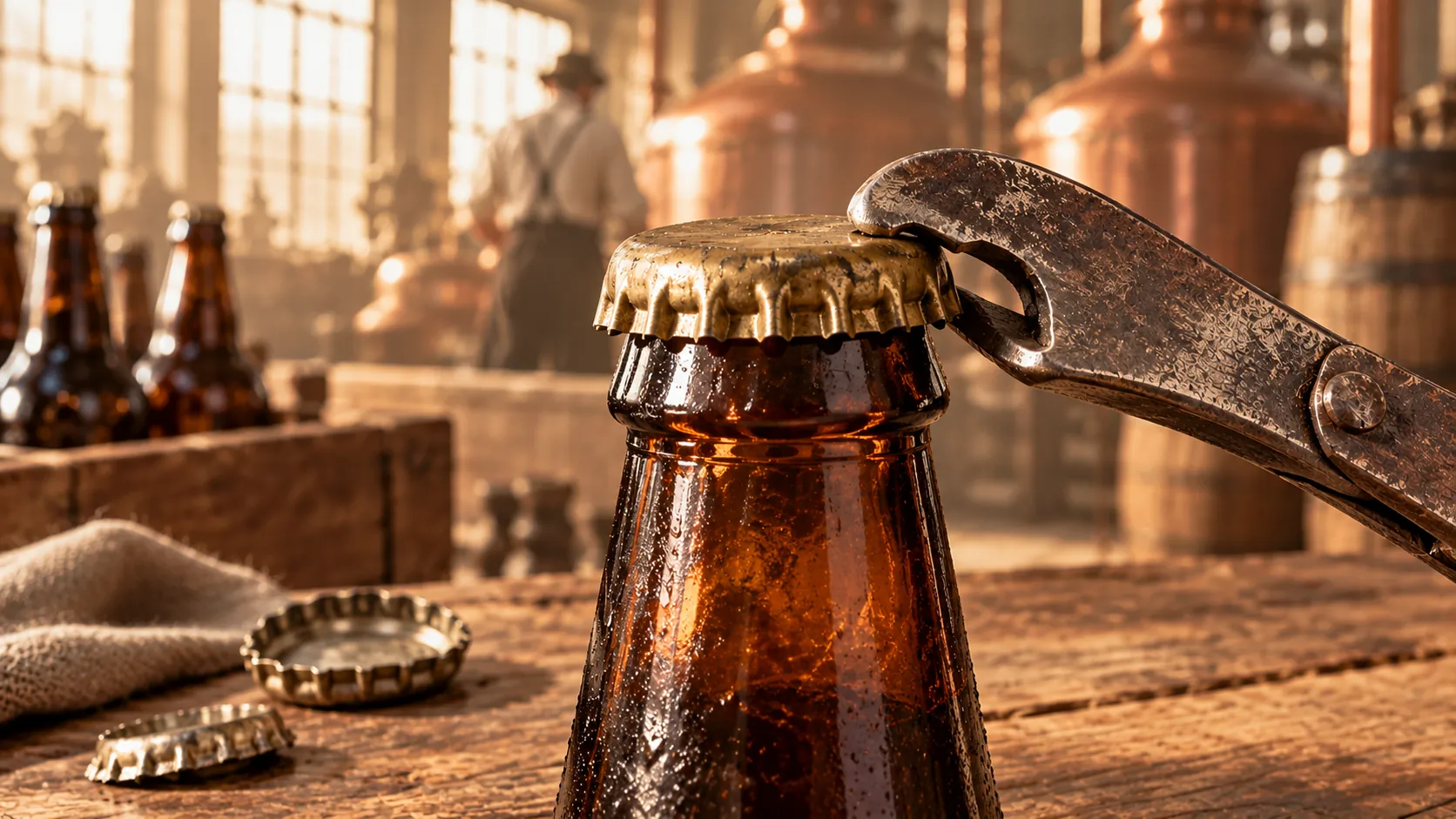
Those little teeth around the edge aren’t just decoration. They are the descendants of an invention more than 130 years old — one that helped transform the way carbonated drinks, including beer, could be bottled and sold.
And the man who solved the sealing problem created another problem in the process.
Once the bottle was properly sealed, people needed a reliable way to open it.
So he patented that too.
Bottled Beer Had a Problem
By the late 19th century, bottled carbonated drinks were already popular.
But sealing them reliably was another matter.
Carbon dioxide creates pressure inside the bottle. A closure had to keep that pressure in, prevent leaks and still be practical and economical for commercial bottling.
Inventors tried all kinds of solutions.
Corks, internal stoppers, wires, rubber seals and mechanical closures all competed for the job. Contemporary bottling history shows an extraordinary burst of invention: more than 300 U.S. bottle-stopper patents were issued between 1882 and 1890.
Everyone was trying to solve the same deceptively simple problem:
How do you cheaply and reliably seal a pressurised bottle?
One inventor in Baltimore spent years working on the answer.
His name was William Painter.
William Painter’s Tiny Idea
Painter had already patented earlier bottle stoppers when he developed the design that would make him famous.
On February 2, 1892, U.S. patents were issued for his new bottle-sealing system. The design became known as the Crown Cork.
It looked surprisingly similar to what sits on beer bottles today.
A thin metal cap covered the bottle opening. Around its edge was a corrugated flange — the little pleats or teeth that gave the closure its crown-like appearance.
Inside was a thin cork sealing disc with protective backing. When the metal flange was crimped around a specially shaped shoulder on the bottle neck, the sealing disc was compressed tightly against the bottle lip.
The result was simple, inexpensive and effective.
The early Crown Cork used 24 teeth.
Modern standard crown caps normally use 21.
More than a century later, however, the basic principle behind the beer bottle crown cap remains remarkably familiar.
Cheap Enough to Throw Away
One of Painter’s advantages was not simply that his closure worked.
It could also be made cheaply.
In one of his 1892 patents, Painter explicitly described the metal caps as inexpensive enough to justify throwing them away after a single use.
That sounds completely ordinary today.
In the 1890s, when many bottle closures were designed to be returned or reused, it was an important part of the idea.
But Painter still had another problem.
A clever cap was only commercially useful if bottlers could apply it quickly and consistently.
So the crown needed machines.
The Cap Was Only Half the Invention
Painter continued developing the machinery around his new closure.
By 1898, he introduced a foot-powered syruper-crowner that allowed an operator to fill and cap about 24 bottles per minute.
Now the pieces were beginning to fit together.
A suitable bottle neck. A cheap metal crown. A reliable seal. Machinery capable of applying it quickly.
Instead of thinking of the Crown Cork as one clever little object, it makes more sense to see it as part of a new bottling system.
And that system could scale.
There was just one slight problem.
The new cap was firmly locked onto the bottle.
Now How Do We Open It?
Painter had created a closure designed to grip the bottle securely.
Which meant consumers needed something capable of removing it.
So Painter went back to work.
His application for a capped-bottle opener was filed in 1893, and on February 6, 1894, U.S. Patent No. 514,200 was granted.
The patent describes an opener specifically suited to hard metal sealing caps that were attached firmly enough to require considerable force for removal.
Yes.
The man whose crown cap helped solve the problem of sealing a bottle also patented a tool for getting the cap off.
It is one of those wonderfully simple chains of invention:
Problem: Carbonated bottles are difficult to seal reliably.
Solution: The Crown Cork.
New problem: The Crown Cork is firmly attached.
Solution: A purpose-built opener.
The familiar pry-off bottle opener belongs to the same system Painter helped create.
From 24 Teeth to 21
Painter’s early Crown Cork used 24 teeth around its edge.
Today’s standard crown caps normally use 21.
Other parts of the design changed too.
The natural cork sealing disc was eventually replaced by modern liner materials, while the cap’s skirt was shortened. Bottle manufacturing became more precise and high-speed machinery replaced early manually operated equipment.
Modern crowns can even use specialised oxygen-scavenging or oxygen-barrier liners designed to reduce oxygen exposure and help protect the drink inside.
But put an early Crown Cork beside a modern beer bottle crown cap and the family resemblance is obvious.
The central idea survived.
That may be the most impressive part of the entire story.
The Crown Conquered the World
Painter built a business around his invention in Baltimore. The Crown Cork & Seal Company grew as the crown closure spread through the beverage industry.
The company he founded still exists today as Crown Holdings.
Painter himself eventually held 85 U.S. patents, but the little crown cap became his defining invention.
More Than 130 Years Later
Packaging usually disappears into the background.
That is exactly what happened to the crown cap.
It became so common that we stopped noticing it.
Today you can walk into a bar almost anywhere in the world, order a bottled beer and recognise the closure immediately.
Metal disc.
21 little teeth.
A seal underneath.
Then comes the bottle opener.
Pop.
A few seconds later, the cap is lying forgotten on the bar.
Which is perhaps the greatest compliment an invention can receive.
William Painter helped solve a problem so successfully that more than 130 years later, people around the world still use the basic idea without ever wondering why it looks the way it does.
Now you know.
Next time you open a beer, take a look at the cap before you throw it away.
You’re holding a little piece of 1892.
Leave a Reply